Firmware Release Scope for Optional Hardware: Keep Untested Accessories Out of the Claim
State release applicability at the actual accessory-combination level, and keep test evidence separate from the approved support decision. An accessory appearing in a menu, being detected by the operating system or working alone does not establish that every optional combination is qualified for the delivered release.
This article concerns truthful handover wording and scope records. It does not perform compatibility testing, prescribe electrical limits or approve any real accessory. All combinations and results in the example are fictional. Product support commitments require the appropriate authority and agreement.
1. Define the combination key
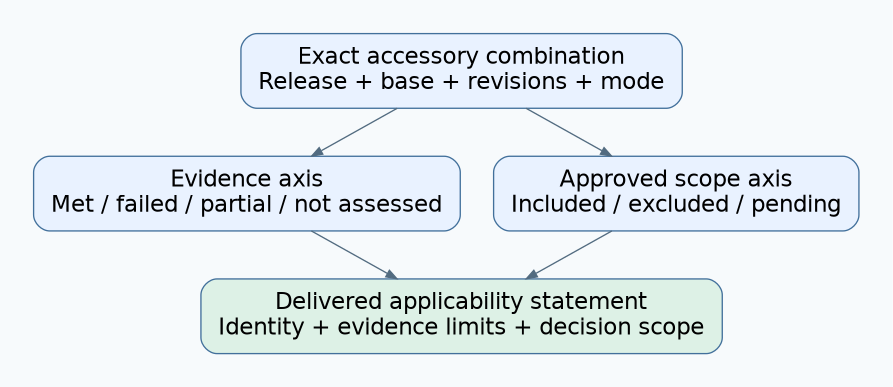
Identify the firmware release, base hardware revision, accessory identity/revision, relevant configuration and simultaneous options. Add the operating mode or external dependency when it changes the claim.
A broad label such as “supports expansion modules” hides whether modules can be used together, which revisions apply and whether a feature was merely detected or exercised end to end.
NASA’s verification-record guidance, section 5.3.1.2.4, ties evidence to identified products and requirements. The original scope matrix below keeps those identities visible when writing the delivered claim.
2. Use two axes instead of one ambiguous status
| Evidence status | Meaning | Support decision remains separate |
|---|---|---|
| Tested, criteria met | Named evidence supports the tested scope | Authorized owner decides the delivered support scope |
| Tested, criteria not met | Identified nonconformance remains | Do not hide failure behind a generic exclusion |
| Partially assessed | Some required claims have evidence | State remaining gaps and any authorized restrictions |
| Not assessed | No adequate assessment for this combination | Do not imply either success or a demonstrated failure |
Separately record whether the combination is included, excluded or pending a support-scope decision. “Unsupported” may describe an intentional product boundary rather than a failed test. Conversely, a successful limited test does not automatically create an ongoing commercial support obligation.
3. Do not infer combined operation from separate results
If accessory A was assessed alone and accessory B was assessed alone, the A-plus-B combination remains a separate claim unless an adequate argument or evidence covers it. Shared resources and interacting behavior may matter, but this article does not diagnose any particular mechanism.
Record what the evidence actually exercised. Basic enumeration is narrower than data transfer; data transfer in one mode is narrower than the full required operating envelope. Avoid replacing these distinctions with a single green compatibility icon.
Where similarity evidence is used, identify the argument and its limits. Do not call the combined configuration directly tested if it was only assessed by analysis.
4. Build a fictional release-scope matrix
| Configuration | Hypothetical evidence | Illustrative delivered statement |
|---|---|---|
| Base unit only | Named required cases meet criteria | Included for the identified release and conditions |
| Base plus accessory A revision 1 | Named accessory cases meet criteria | Included only for the identified revision/mode |
| Base plus accessory B revision 2 | Detection checked; required operation not assessed | Operational support not established |
| Base plus A and B together | No combination assessment | Not assessed; excluded from this release claim |
These rows are synthetic, not customer results. Actual wording must cite real evidence and an approved scope decision. A blank cell should never silently mean pass, supported or not applicable.
Include an explicit unknown-identity case. If the accessory revision cannot be determined, the receiver cannot safely map it to a revision-specific claim merely because the enclosure looks the same.
State whether the evidence concerns a design configuration or particular tested units. A configuration-level statement should not imply that every delivered unit underwent the same individual checks. Keep any unit-specific acceptance evidence separately identifiable.
5. Write scope text the receiver can apply
A fictional bounded statement might read: “The release scope includes the base unit and accessory A revision 1 in the documented mode. Accessory B operation and simultaneous A-plus-B operation were not assessed for this release and are outside this scope. Detection of B does not establish operational support.”
This is sample wording, not an Obeita commitment. Replace every identity, mode and evidence statement with verified project facts before distribution. Link the controlled matrix through an authorized accessible reference.
Do not use “all standard accessories” unless that set is explicitly defined and adequately supported. Marketing names can outlive component revisions and silently expand a statement beyond its evidence.
6. Keep exclusions useful and honest
An exclusion should identify the combination, reason category and route for obtaining a decision. Distinguish no assessment, known nonconformance, unavailable prerequisites and deliberate product-scope limits.
Where a known failure exists, preserve the relevant limitation and approved operational guidance. Do not reclassify it as merely untested to make the release summary look less concerning.
A request to add an accessory should trigger the actual compatibility and support-scope process. The release-note author should not manufacture acceptance criteria or promise a qualification date to fill the gap.
7. Reconcile every place the claim appears
Compare the matrix, release notes, installation guide, user interface labels and handover summary. If the UI offers an option outside the approved release scope, explain its status accurately rather than relying on a hidden appendix.
NASA’s configuration-management guidance, section 6.5, emphasizes identified configurations and controlled changes. Bind the scope statement to the release and matrix revision so later accessory additions receive a deliberate update.
The final claim should let a receiver identify their actual combination and see its evidence state, approved scope and unresolved limitations. That delivers a truthful applicability boundary without implying universal accessory qualification or creating unapproved support commitments.