Pinmux Handover at Boot: Prevent a Safe GPIO from Glitching into an Active Output
A safe steady-state GPIO value does not prove a safe boot handover. Treat reset defaults, firmware configuration, kernel pinctrl selection, and driver initialization as separate transitions. At every boundary, identify which block owns the pad and which value becomes visible when its output path is connected.
Applicability: this procedure uses Linux v6.12 pinctrl and GPIO consumer behavior. The active-high enable example is hypothetical. No particular SoC pad sequence, voltage threshold, or pulse tolerance is assumed; those details must come from the selected processor, board schematic, and receiving component.
1. Describe the forbidden transition at the receiver
Suppose a hypothetical peripheral must remain disabled until configuration is complete. Its enable input is active high, so the required startup condition is a valid low at that input. Write the requirement in terms of the receiver, including its supply state, rather than merely “GPIO register equals zero.”
List the complete path: processor pad, any inverter or translator, external bias, connector, and receiving input. A low output latch has no effect while another function owns the pad. An input-mode pad may depend on external bias, and an unpowered translator may behave differently from a powered one.
For each boot stage, record mux function, direction or output-enable state, output latch, bias configuration, and responsible software. Mark unknown reset values explicitly. This table exposes the dangerous gap between the last action of the old owner and the first effective action of the new owner.
2. Locate the kernel’s actual pinctrl boundary
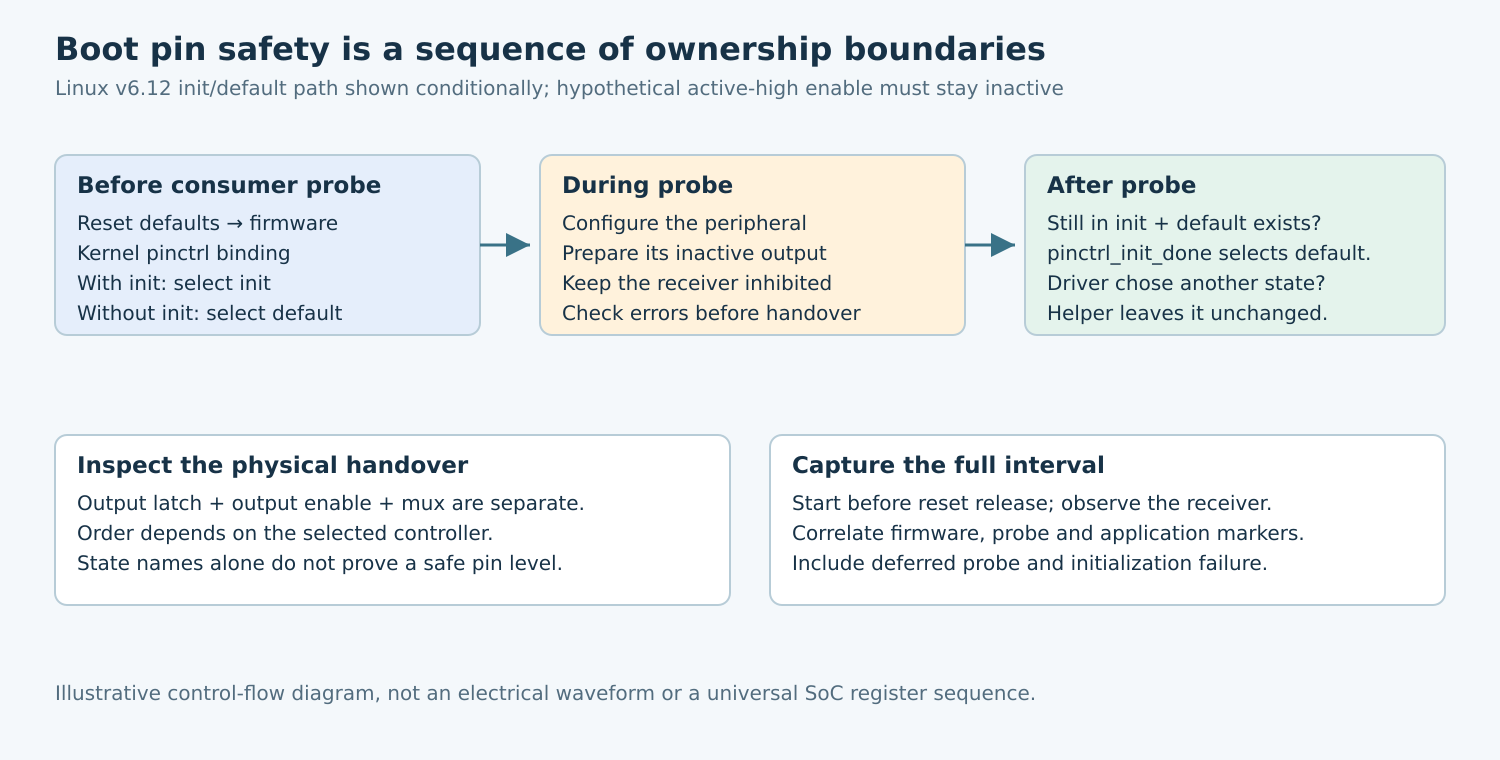
In the v6.12 device-core pinctrl binding, the core looks up a default state before probing. If an init state exists, it selects init; otherwise it selects default before the driver’s probe runs. A driver cannot assume that its first initialization statement precedes every mux change.
The v6.12 pinctrl_init_done implementation switches from init to default after probing only when the current state is still init and a default state is available. If the driver selected another state, this helper leaves that state alone. Missing states and configurations without this pinctrl path need separate analysis.
For a device whose peripheral output must be configured before connection, an appropriate init state can provide a preparation interval. It is not automatically safe: inspect what that state actually programs and whether the provider can implement the requested settings. A state named safe or init carries no electrical guarantee by its name.
3. Review latch, enable, and mux as independent operations
The pinctrl documentation distinguishes multiplexing, pin configuration, and GPIO operation. Hardware relationships vary; a GPIO block may be disconnected by the mux, or some GPIO capability may coexist with a peripheral function. Provider ownership restrictions also vary.
Derive the transition sequence from the actual controller. If supported, preparing an inactive output latch before enabling its drive path can avoid exposing an old latch value. On another controller, a peripheral’s idle output must be established before mux selection. Do not turn this pattern into a universal register-write order.
For a genuine GPIO consumer, acquire or configure the output with its intended initial logical value rather than requesting output direction and fixing the value later. The GPIO consumer interface provides initial-value flags and a direction-output operation with a value argument for this purpose. Check errors and translate logical polarity correctly.
Do not obtain a second GPIO descriptor solely to fight a peripheral driver’s pinctrl state. Nor should a permanently reserved GPIO hog be assumed to transfer ownership automatically to a later consumer. Resolve ownership in the board description and driver design; competing owners can make a boot workaround fail during reprobe or resume.
4. Build an event-indexed capture plan
Use a controlled development fixture that keeps consequential loads inhibited independently. Observe the receiving input, relevant supply or power-good signal, and available reset or software markers. Choose instrument bandwidth and thresholds from the receiver’s specified sensitivity and the transitions under investigation.
Capture from before reset release through application enable. Preserve enough pre-trigger history to see the firmware-to-kernel boundary. A capture started after the driver reports success cannot exclude a short unwanted assertion during early boot.
- Reset to firmware: confirm the pad’s reset behavior and the first firmware configuration step.
- Firmware to kernel: identify any change before the consumer driver’s probe begins.
- Probe entry to completion: correlate init-state selection, peripheral setup, and any explicit driver state changes.
- Default-state connection: inspect the first visible output after the normal mux path is selected.
- Application enable: confirm that this is the first permitted assertion at the receiver.
Software timestamps help locate a transition but do not establish its exact electrical ordering. Use hardware markers where practical, and record marker latency or uncertainty instead of treating log output time as a pad-edge timestamp.
5. Test the branches that bypass the happy path
Repeat cold boot and warm reset, since retained controller state can make one look safer than the other. Include a delayed provider, deferred probe, driver initialization failure, and a supported unbind/rebind cycle. Use fault injection only on a fixture where the peripheral cannot cause harm.
For every branch ask who holds the safe condition while initialization is incomplete. A default state selected before probe may expose the peripheral early; an init state retained after a failure may be safe electrically but leave the device unavailable. Record both outcomes rather than accepting silence as success.
If the unwanted pulse occurs before Linux takes control, changing the consumer driver cannot remove that earlier event. Review reset bias and firmware. If it aligns with default selection, inspect the preparation-to-connection sequence. If it appears only after application enable, investigate the operating driver rather than continuing to adjust boot pinctrl.
6. Close the handover contract
The final artifact should name every owner, its incoming assumptions, its outgoing state, and the capture that checks the transition. Store the bootloader version, kernel commit, device tree, board revision, and relevant controller documentation with the evidence. A later pinctrl change can invalidate a previously good waveform without changing application code.
No boot waveform was measured for this article. The proposed acceptance condition is receiver-level safety throughout the complete ownership timeline. Where software cannot guarantee the required early state, use an independently justified hardware inhibit or bias arrangement and verify that arrangement under the actual power sequence.