Fixture Self-Test Before the DUT: Detect Broken Cables and Relays with Known Challenges
A fixture self-test should challenge the exact paths that will support the next DUT result. Use known stimuli or reference loads, require the corresponding observations and record which cables, switching routes and measurement functions were exercised. One successful loopback cannot validate every relay position or the final contact with the product.
This is an original proposed qualification procedure informed by NASA SP-2016-6105 Rev2 and NIST check-standard guidance. No relay, cable, load or instrument was operated. Every physical challenge requires the actual schematic, component ratings and approved safe switching sequence.
Define the fixture’s claim before designing the loopback
List the fixture functions the production test relies on: stimulus delivery, measurement return, route selection, power distribution, digital communication and detection of absent connections. Associate each with the product requirement it helps verify.
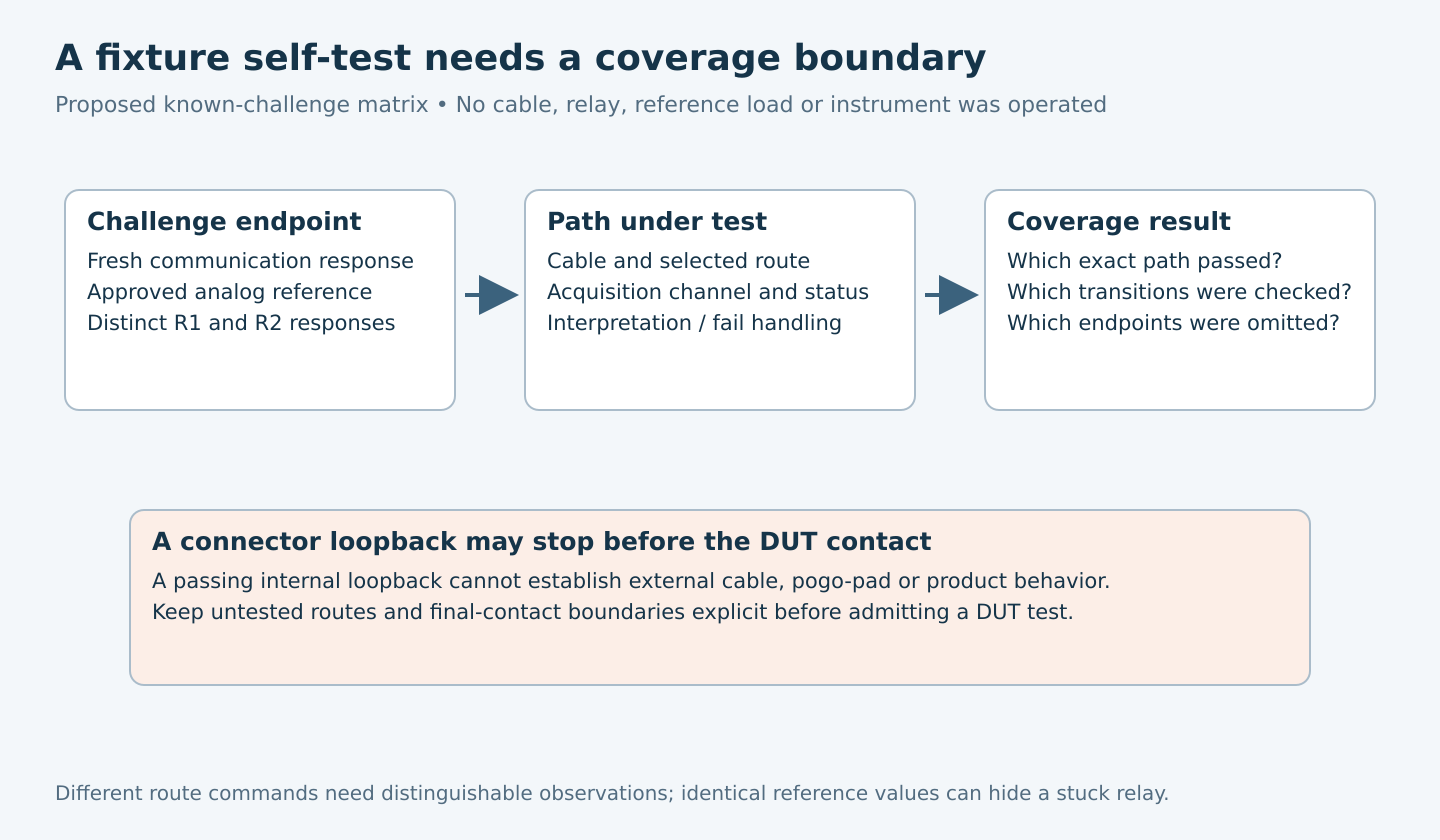
Draw the boundary of the self-test artifact. A plug at the fixture connector can cover the cable up to that connector but omit spring contacts and the DUT pad. An internal relay-board loopback can omit the entire external harness. Label these exclusions explicitly.
The NASA verification guidance requires identifying test configuration, equipment and relevant differences from the intended product configuration. Applied to a self-test, that means documenting what was actually exercised rather than reporting a broad “station good” conclusion.
Build a route-to-challenge coverage matrix
| Fixture function | Proposed known challenge | Required observation | Uncovered boundary |
|---|---|---|---|
| Communication cable and return. | Qualified endpoint responds to a fresh request. | Correct framed response for this self-test instance. | Product firmware and final board contact. |
| Switched analog route R1. | Approved reference at the R1 endpoint. | Expected value/range on the intended channel. | Other route positions and unrepresented loads. |
| Route separation. | Different distinguishable references on reviewed endpoints. | Changing route changes the observation as predicted. | Every possible short or dynamic coupling mechanism. |
| Failure reporting. | Safe known-invalid response or disconnected test artifact. | Self-test fails with the correct reason. | Unexercised parser and hardware failures. |
The matrix is conceptual. It does not prescribe resistor values, voltage levels or a universal disconnected-input stimulus. Some inputs cannot safely float, and some switching networks must not change route while energized. The approved design determines how each challenge is implemented.
Use distinguishable responses to expose a stuck path
Imagine a hypothetical fixture with routes R1 and R2. If both reference endpoints return the same nominal value, a relay stuck on R1 can appear to pass both commands. Choose safely distinguishable approved challenges so the expected observation depends on the selected route.
Record command intent, available route readback and observed response separately. A controller acknowledging “select R2” does not prove that the physical contacts moved. Conversely, a distinctive response through R2 supplies useful path evidence without proving that every unused contact is open.
Include transitions in both directions and the starting state. Testing R1 then R2 only after a fresh reset may miss a route that fails when returning from R2 to R1. Preserve the sequence because relay state and settling can depend on what happened immediately before.
Challenge the observer as well as the signal path
A self-test that always sees a plausible cached value can pass while acquisition is broken. Bind responses to the current request or acquire fresh readings through the instrument’s documented procedure. Record acquisition status, selected channel and applicable configuration.
Use a known negative control to verify that the harness can reject an incorrect response. Begin with a software fake or preserved raw fixture when physical fault insertion is unnecessary. A deliberately wrong expected result should not be transformed into success by a permissive parser or a default-value path.
Do not confuse a software negative control with a physical open-circuit test. It proves a different part of the chain. Keep the challenge matrix split by stimulus generation, routing, acquisition and interpretation so each result has a bounded claim.
Keep reference artifacts under control
NIST’s check-standard discussion emphasizes stable, representative artifacts and their measurement histories. A worn self-test plug or drifting reference load can become the source of station alarms, or can conceal a matching station drift.
Assign the artifact an identity and revision. Record its qualification method, operating scope, inspection history and replacement criteria. Do not treat a resistor’s marked nominal value or a previously passing board as an unchanging truth without the relevant evidence.
Where a reference is shared among stations, record which station used it and when. Handling damage can otherwise appear as a sudden common station failure. Use an independent comparison or requalification when the reference itself becomes suspect.
Gate DUT admission on current coverage
Associate a self-test result with the fixture configuration it qualified. Invalidate the relevant coverage after cable replacement, relay-board maintenance, instrument configuration changes or another event that can alter the path.
Define a justified recurrence schedule and event-based checks. A self-test at the start of a shift is not perpetual permission after a connector is replaced. Equally, repeating a lengthy full campaign before every unit may add wear without addressing the dominant failure mechanism; choose the schedule from the actual control plan.
If only one route is qualified, restrict admission to tests whose required paths are covered, if the product process permits that limited operation. Otherwise hold the station. Missing coverage should remain visible rather than being filled by the last successful result from another route.
Close failures without hiding the original evidence
Preserve the failed self-test, investigation, corrective action and subsequent qualification. If a fixture defect is confirmed, evaluate whether earlier DUT results used the affected path and whether the onset can be bounded. A later passing self-test does not retroactively validate them.
Deliver the route drawing, challenge matrix, reference-artifact record, expected observations and explicit exclusions. The useful outcome is a justified permission to use particular fixture functions under particular conditions. “Loopback passed” is only one observation within that broader evidence chain.