Choosing a Stable Linux Device Interface: Stop Shipping Applications That Depend on debugfs
Give production applications a documented interface whose semantics are maintained, and keep debug-only files out of the application’s required startup path. Moving a filename from debugfs to sysfs is not enough. The contract must define what a value means, who may change it, how errors appear and what survives an upgrade.
This article uses upstream Linux v6.12 interface documentation. It proposes an inventory and regression procedure for a device application; it does not promise that every vendor attribute is stable because of its filesystem location. No device settings, mounts or access permissions were changed.
Find dependencies that were introduced as shortcuts
Inventory every kernel-facing path opened by the application, startup scripts, monitoring agents and service helpers. Record read and write behavior separately. A developer may have added a debugfs counter during bring-up and later made the service refuse startup when that counter is absent.
For each dependency, identify the owning subsystem or driver, documentation, expected format, units, permissions and reason for use. Include dynamically constructed filenames and fallback paths. A search for one literal mount path is insufficient when a wrapper hides the dependency.
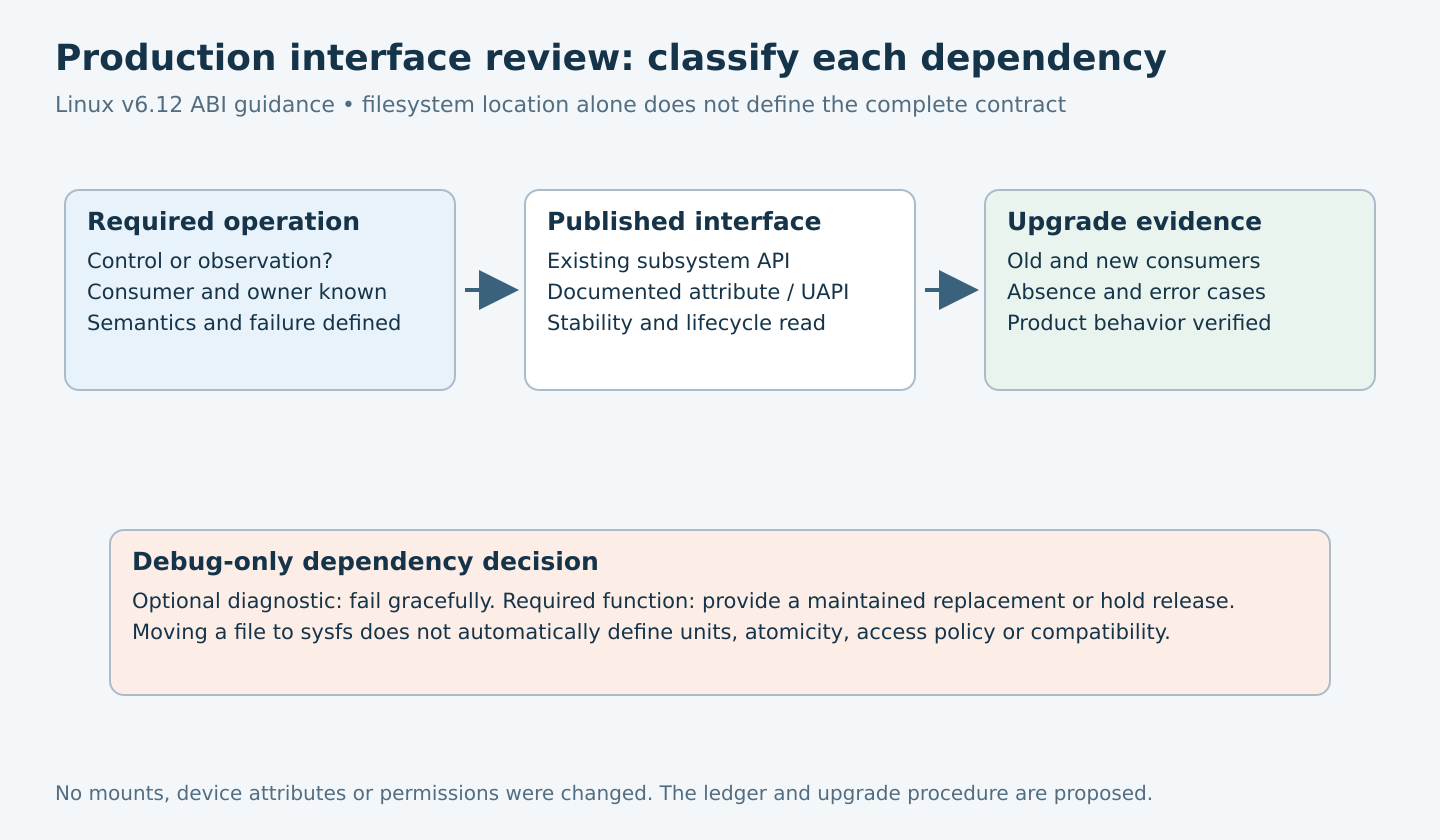
Classify each use as necessary control, necessary observation, optional diagnostic or obsolete workaround. That classification determines the repair. An optional troubleshooting counter can often fail gracefully; a required control operation needs a maintained replacement before removing the old path.
Read the declared stability boundary
The v6.12 debugfs guide explicitly says that debugfs is not intended to provide a stable userspace ABI. Its flexibility is useful for diagnostics, but file names, formats and behavior are not a sound default contract for independently maintained production software.
The guide also acknowledges that real consumers can create long-term maintenance obligations. Do not interpret its warning as permission to break an existing deployed dependency without migration planning. Record the dependency, agree on a supported replacement and test old consumers through the transition.
The kernel ABI registry distinguishes stable, testing, obsolete and removed entries. Testing does not mean arbitrary churn: its description expects current interfaces to remain compatible when features are added, with exceptions such as grave defects or security problems. Obsolete means a removal path must be understood. Read the individual entry and release history, not only its directory label.
Kconfig symbols and kernel-internal symbols are explicitly outside that stable ABI promise. They can help engineers qualify a build, but an application should not infer a maintained operational capability solely from a particular internal symbol’s continued existence.
Select an interface for the operation’s semantics
The sysfs documentation describes attributes associated with kernel objects. Text values are generally preferred, with one value per file and limited same-type arrays where appropriate. A readable attribute can suit an object’s state, but a custom sysfs file still needs documented meaning and lifetime.
For file-descriptor-oriented operations, an existing subsystem API or carefully designed ioctl may be appropriate. The ioctl guidance favors subsystem abstractions and points to alternatives, including netlink for network-object configuration. Reuse a maintained subsystem contract when it already represents the operation.
Do not force a multi-step transaction into several writable attributes without defining concurrency and partial failure. If two values must change atomically, separate file writes may expose an invalid intermediate state. Interface selection follows the required operation, not whichever helper function is quickest to add.
Build a concrete dependency ledger
| Ledger field | Evidence to retain |
|---|---|
| Consumer and purpose | Application code path and required product behavior |
| Interface identity | Subsystem, attribute or command, and discovery method |
| Published contract | Exact ABI entry or maintained API reference and release |
| Representation | Units, valid range, encoding, optional fields and errors |
| Availability | Device lifetime, permissions and required configuration |
| Upgrade disposition | Keep, migrate, make optional or block release pending support |
Consider a hypothetical service reading a diagnostic file called raw_state and comparing its third whitespace-separated token with a literal number. The failure risk is not only that the file disappears. A developer can add a column or change the internal state numbering while preserving a plausible-looking line.
A maintained replacement should expose the product-relevant state with defined values and errors. If no suitable upstream interface exists, the product team must own and document its private ABI explicitly, including compatibility tests. Calling that private interface “stable” without a maintenance owner does not create support.
Test absence and change before the upgrade ships
- Capture the baseline application’s actual interface use during startup, normal operation and recovery.
- Exercise the candidate image with the same hardware identities and workload.
- Compare documented values and semantics rather than raw directory listings.
- Use a controlled fixture to make optional diagnostics unavailable and verify the intended degraded behavior.
- Test invalid values, denied access and device disappearance at the application boundary.
- Repeat with every still-supported application version that can run on the candidate image.
Use test doubles or an isolated target for missing-interface cases. Do not unmount a shared diagnostic filesystem or change global permissions on a production device merely to simulate absence. Preserve the distinction between an unavailable interface and a valid value of zero.
A candidate that works only when debugfs is mounted may reveal an unresolved production dependency. Conversely, a deliberately scoped service tool may legitimately require a matching diagnostic build. Keep that tool’s support matrix separate from normal product readiness.
Migrate without inventing compatibility
Introduce the new consumer path with explicit capability detection and bounded fallback behavior. Detect the supported operation, not merely a kernel version string; vendor backports and configuration can change availability. Reject ambiguous data rather than interpreting an unfamiliar format as the old one.
Where old applications must continue operating, retain a reviewed compatibility path or stage the application and kernel update together. Do not mask a broken contract with broad filesystem permissions or a symlink to a semantically different file. A matching path cannot make different units or write behavior compatible.
Close the change with a ledger showing no unexplained required debug-only dependency, tests for each supported consumer, and a documented outcome when optional diagnostics are absent. The objective is a maintainable application-kernel relationship with observable upgrade behavior, not simply a cleaner mount tree.