Modbus Serial Diagnostics: Use Function 08 Counters Without Treating Them as Universal Telemetry
Function 08 counters can help distinguish receive-path problems from protocol-processing exceptions, provided the device supports the relevant subfunctions and their meaning is known. Use timestamped differences over a controlled observation window. Do not interpret one absolute count as a current fault, and do not treat every diagnostic subfunction as a harmless read.
The reference boundary is Modbus Application Protocol V1.1b3, dated 26 April 2012, together with Modbus over Serial Line V1.02, dated 20 December 2006. This guide concerns serial-line diagnostics, especially RTU counters. A gateway or device firmware may support only a subset or expose different documented behavior; no particular device implementation is certified here.
Start with a read-only subfunction allowlist
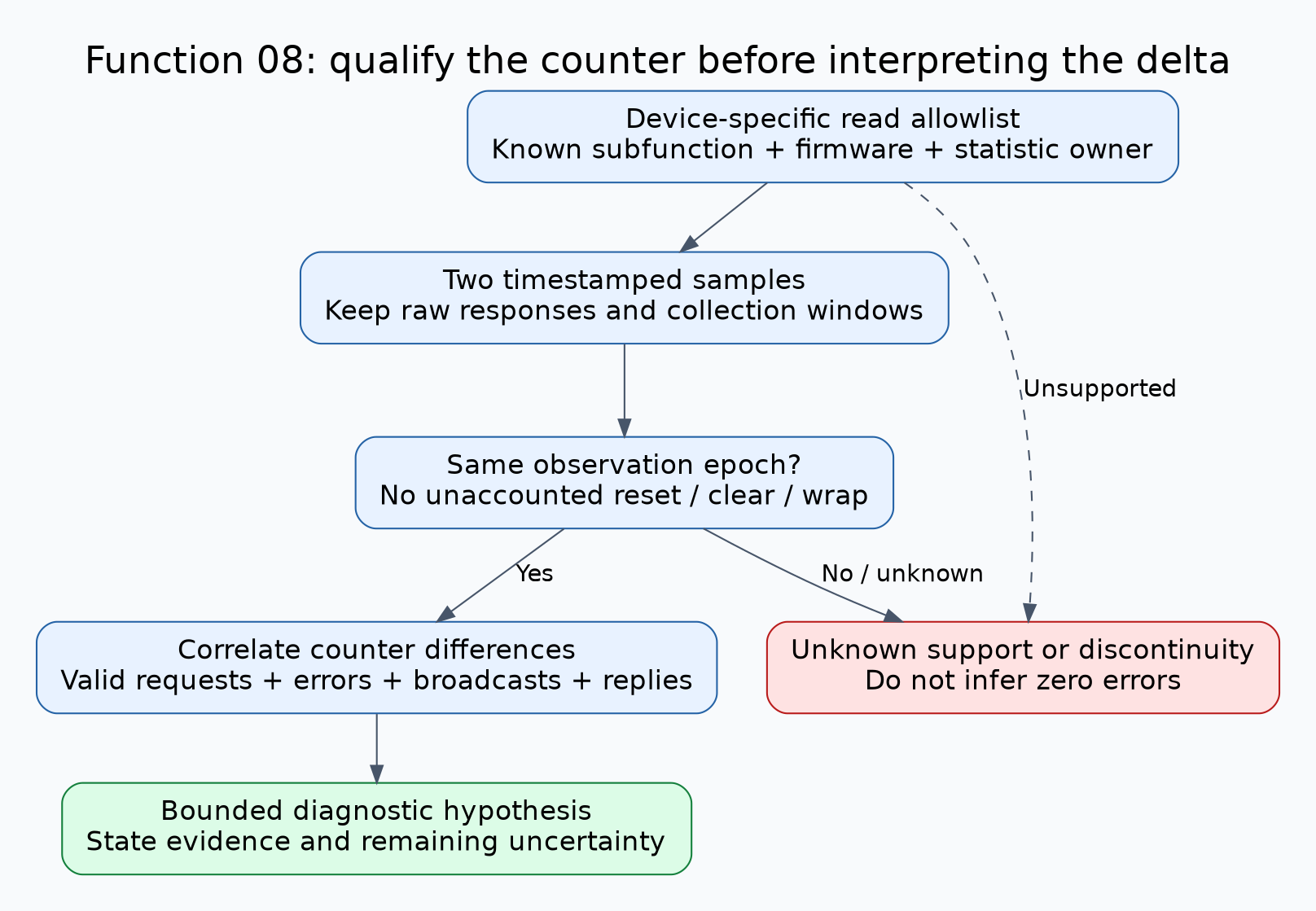
Inventory supported diagnostic reads from the exact device manual and firmware revision. Record the permitted target address, serial interface and request format. Verify that the gateway forwards the request to the intended serial device instead of answering from its own statistics. Unsupported and unreachable are different outcomes and need different labels.
The V1.1b3 application specification, section 6.8 includes controls that restart communications, clear counters or force listen-only operation. Therefore, a scanner that blindly tries every Function 08 subfunction can change the device under investigation. Keep those controls outside the diagnostic-read workflow. Preserve existing counters rather than clearing them merely to make a graph start at zero.
Use an isolated bench device for support discovery when the manual is incomplete. A production timeout is not permission to send progressively more disruptive diagnostic commands. In particular, an absent response after a state-changing operation may be the operation’s defined behavior rather than a new wiring failure.
Use the serial guide’s counter meanings
Appendix A of the Serial Line V1.02 guide supplies details that short counter names hide:
- 0x000B, bus messages: excludes messages with a bad CRC.
- 0x000C, communication errors: includes CRC faults and specified character-level or too-short-frame cases where CRC calculation is not possible.
- 0x000D, exception errors: includes qualifying broadcast errors even when no exception reply is sent.
- 0x000F, no response: includes broadcast messages; an increase need not mean a missing unicast reply.
The application specification’s concise descriptions and the serial guide’s detailed counter rules should be read together. Ask the vendor which behavior the selected firmware implements, especially if a test seems inconsistent. Do not relabel a communication-error counter as “CRC failures only” or a no-response counter as “network packet loss” without establishing that narrower meaning.
Make each sample an interval with context
A useful sample contains the device identity, firmware, serial configuration, subfunction, returned value, response status and collection timestamp. Record the start and end of a multi-counter collection because separate reads are not an atomic snapshot. Preserve raw responses so a later decoder correction does not require reproducing the fault.
Before calculating a difference, establish whether the device restarted, counters were cleared or the firmware changed. A smaller later value can indicate a reset or wrap; it is not automatically a negative error rate. Use modular arithmetic only when the device’s counter-width and wrap behavior are documented or demonstrated. If that evidence is missing, mark the interval discontinuous.
Counter polling is itself traffic. Include its requests and responses in the observation record, and choose a sampling cadence that does not materially change the workload being investigated. Avoid comparing a quiet baseline with a fault run that adds a dense diagnostic poller and then attributing all new errors to the original application.
Correlate changes with an independent traffic record
Capture the client’s attempted transactions and, where practical, the serial traffic seen near the device. Distinguish complete valid requests, malformed traffic, broadcasts and replies. Then compare those observations with counter differences over the same interval.
- A rising communication-error count supports investigation of the receiver’s framing or integrity path. It does not identify a cable, transceiver or software parser as the cause by itself.
- A rising exception count with observed valid request/reply exchanges supports a protocol-processing investigation. Identify the requests and exception responses rather than guessing from the total.
- A stable counter during client timeouts does not prove the link is healthy. The request may not have reached the device, the counter may be unsupported, or the observation window may be wrong.
- An increased no-response count alongside broadcasts may be expected. Separate those transactions before using the count to investigate unanswered unicast requests.
Do not divide one counter by another and publish a failure percentage until the numerator and denominator refer to the same event population. The device’s bus-message count and a client’s issued-request count can cover different traffic and different observation points.
Qualify interpretation with controlled cases
The following proposed tests have not been run on hardware. Use a safe bench setup and documented read-only application requests; deliberately malformed traffic belongs only in a controlled test environment.
- Read each supported counter twice during a known quiet interval. Confirm stable decoding and account for the diagnostic traffic.
- Run a fixed sequence of valid requests and record which counters change.
- Exercise a documented, safe exception-producing read against the bench device, then correlate the observed exception with the counter change.
- If required for qualification, introduce one controlled receive error with suitable test equipment and compare the device counter with the capture.
- Exercise the product’s normal broadcast pattern on the bench and verify the no-response interpretation.
- Restart the bench device through its approved procedure and verify that the collector starts a new observation epoch instead of generating a false delta.
Stop if a diagnostic read changes operation unexpectedly, the gateway’s source of statistics is unclear, or the counter response does not match the documented format. Record the limitation rather than silently substituting zero.
Hypothetical example: three new errors are not three lost replies
Imagine a hypothetical serial controller where the communication-error count changes from 12 to 15 during a test, while the exception counter remains unchanged. The client also reports several timeouts. Those invented values are a reasoning example, not measurements.
A trace shows three damaged receive events and additional requests that never appear at the device observation point. The counter supports the first group but cannot account for the second. Treating the difference of three as a complete count of all failed application transactions would hide part of the problem.
The resulting report should state the supported counter semantics, valid observation interval, correlated traffic and remaining unknowns. This turns Function 08 into a useful diagnostic instrument without promising that every device exposes the same telemetry or that counters alone can locate the fault.