Yocto Shared-State Cache: Distinguish a Reusable Task Result from a Reproducible Release
A release build finishes quickly because most work is recovered from shared state. That is useful operational evidence: the build found reusable task results. It does not, by itself, demonstrate that the same source and configuration can independently reproduce the released binaries. Treat cache reuse and reproducibility as separate claims with different tests.
The distinction matters when a product must be maintained after the original build machine disappears. A cache can accelerate the next build, while a reproducibility record explains what the build is expected to produce. This article uses Yocto Project 5.0.12 documentation and proposes a release-check procedure. It reports no executed builds or measured cache performance.
State the claim before choosing the test
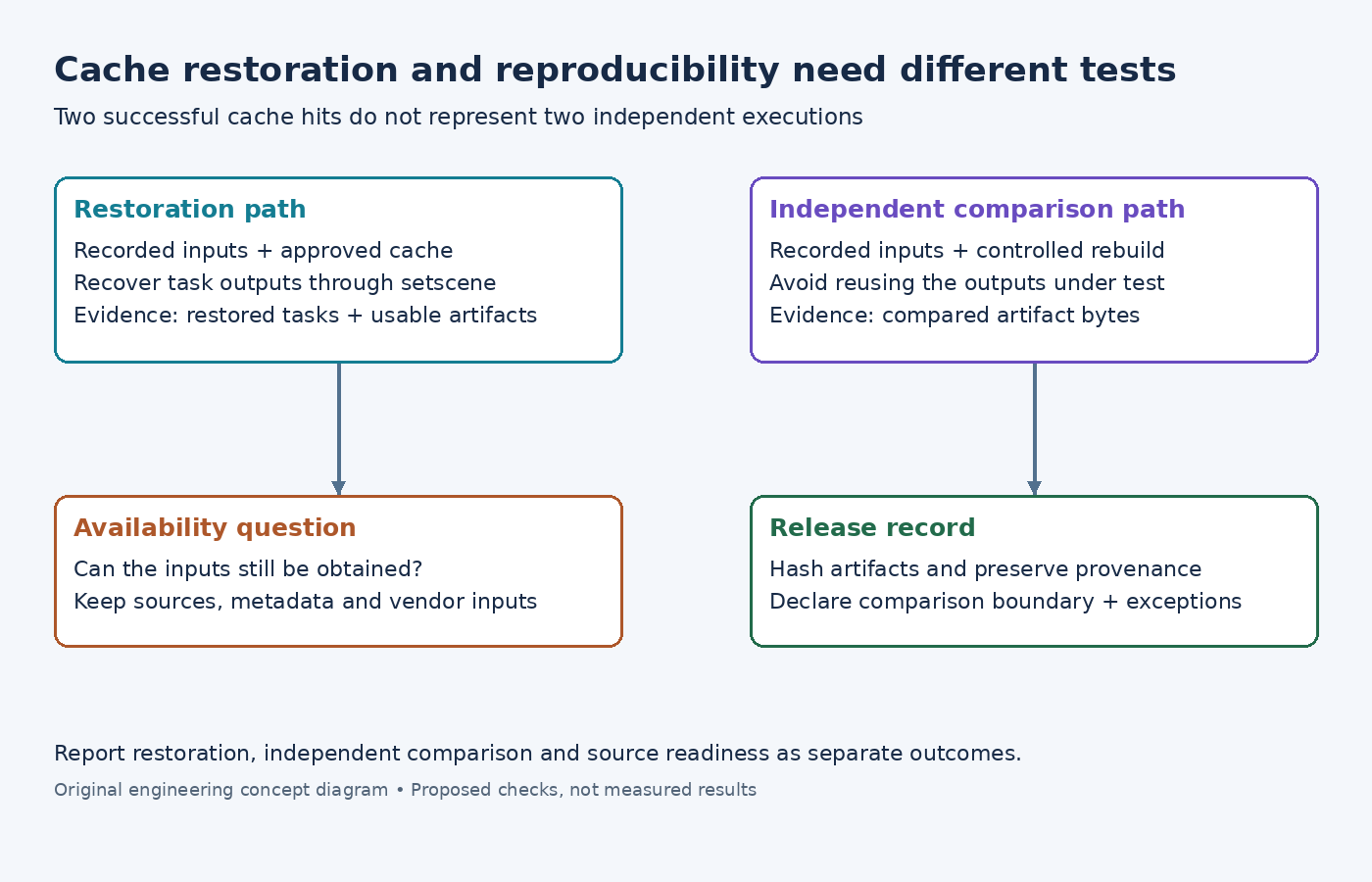
Write down which question needs an answer. Can a second workspace reuse stored task outputs? Can the selected inputs rebuild without those outputs? Do independently generated artifacts match? Can the release inputs still be retrieved later? These questions overlap operationally but are not interchangeable.
For a cache-restoration check, the expected result is that valid stored outputs are recovered and the resulting artifacts are usable. For a reproducibility check, the expected result is agreement between independently produced outputs under a defined input and comparison policy. For long-term rebuild readiness, the sources, metadata, tools, and necessary configuration must remain available.
The shared-state concepts section explains task-based output reuse through setscene processing. A consumer can receive a stored result without the producer repeating its original work. That is exactly why reusing the same cached result twice cannot establish that two independent executions would agree.
Preserve a release identity independent of cache location
Create a release record that names the image and machine, layer revisions, selected source revisions, configuration changes, and produced artifact hashes. Include local patches and any external binary inputs. A cache path is useful operational context, but it is not a substitute for those identities.
Record the hash-equivalence and mirror configuration used for the build as well. If a later investigation compares two different build environments, these settings help explain which work actually executed. Keep the actual deployment files with the record rather than relying only on mutable symlinks or a filename that can be reused.
Separate missing source from missing cache. Losing a cached task result may make a build slower. Losing the only available source archive or vendor input can make rebuilding impossible. That distinction should drive retention priorities instead of treating every directory under the build tree as equally valuable.
Design two checks with different evidence
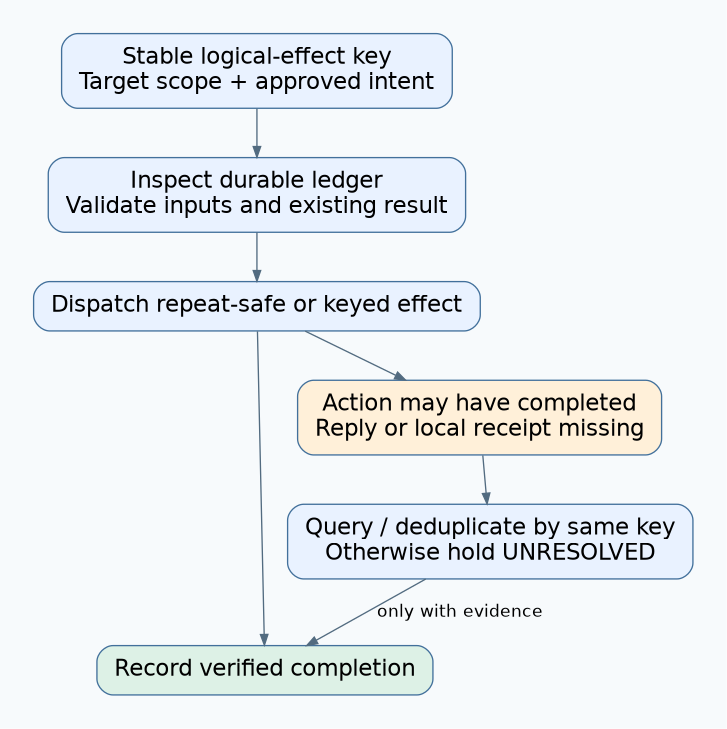
For the restoration check, use a separate work directory and the intended shared-state source. Confirm that the relevant tasks were restored rather than merely trusting the elapsed time. Inspect the resulting deployment artifacts and exercise the product's basic acceptance check. Keep logs that associate the restored results with the recorded configuration.
For the reproducibility check, use a procedure that forces the selected outputs to be produced independently. The Yocto reproducibility test guide documents an automated selftest, including a second build that disables shared state except for explicitly configured exceptions. It also makes clear that added layers require their own validation. Do not carry a core-project claim over to a custom product automatically.
A product team can start with a focused target set before expanding to a full image. Define that set in the test record and retain any shared-state exceptions. An exception is not automatically wrong, but it limits what the result establishes. A test of one application recipe does not prove that a separately generated disk image is reproducible.
Compare artifacts at a declared boundary
Decide in advance which bytes or properties must agree. If the goal is binary reproducibility, compare the selected artifact bytes and investigate every difference. If a release process intentionally adds a signature or provisioning data afterward, record that transformation separately and define the earlier reproducible boundary precisely.
Do not normalize away unexplained differences until the hashes match. A timestamp, path, or ordering difference can reveal a real uncontrolled input. Inspect the difference, identify its producer, and decide whether the build should eliminate it or the release comparison should explicitly exclude it. The decision and rationale belong in the result.
Use a structured discrepancy record: artifact, differing region or file, likely generating task, observed input difference, and proposed correction. This makes a failed test actionable without turning every mismatch into a claim of a security incident. Reproducibility testing detects disagreement; it does not alone establish its cause.
Keep reuse and trust separate too
The BitBake setscene description describes compatibility-based reuse. Operationally, also control who may write to the cache and which cache sources a release build accepts. A matching build-system identity is not a complete organizational trust policy for externally supplied binaries.
Keep experimental cache writers separate from the release process when that separation is required by the project's threat model. Preserve enough provenance to investigate a suspicious restored result. These are release-engineering recommendations; the article does not claim that signatures or a cache configuration provide a particular security certification.
Close with three explicit outcomes
A useful report can say that restoration passed, independent comparison failed on a named artifact, and source retention remains incomplete for one vendor component. That is more informative than a single green build status. It tells the next engineer which property is established and what still blocks a maintainable release.
The work is complete when the team can recover stored outputs, independently validate the chosen reproducibility boundary, and locate the inputs needed to repeat the process. Shared state remains valuable throughout. Its value becomes clearer when successful reuse is recorded as the specific capability it demonstrates, alongside the separate evidence required for a reproducible release.