U-Boot Console Silence: Qualify Diagnostics Across SPL, Relocation and Linux Handoff
A product boots quietly in the laboratory, but a field failure leaves
no useful early log. Removing routine output can be reasonable; treating
silence as one switch for the entire boot chain is the risky part. SPL,
main U-Boot and the subsequent Linux command line can follow different
rules, and an environment change may take effect only at a particular
point.
The mechanisms below are scoped to upstream U-Boot v2025.01. A
Buildroot product should check its selected bootloader build and board
console routing. The proposed tests need a recoverable diagnostic setup.
They have not been executed here.
Start with a
stage-by-stage output contract
List the stages from reset to the application and identify which
diagnostic channel exists at each one. Include the boot ROM and any
vendor firmware as separate owners; U-Boot’s console configuration
cannot establish what those components emit. Within U-Boot, distinguish
SPL from main U-Boot and distinguish output before environment
availability from output after relocation.
For each stage, state what the product expects to suppress and what a
service engineer must still be able to recover. A blank terminal is not
enough to demonstrate the requirement. It can mean deliberate silence,
an uninitialized UART, an incorrect pin configuration or a hang before
the logging point. The qualification plan needs an independent way to
distinguish those cases.
The console
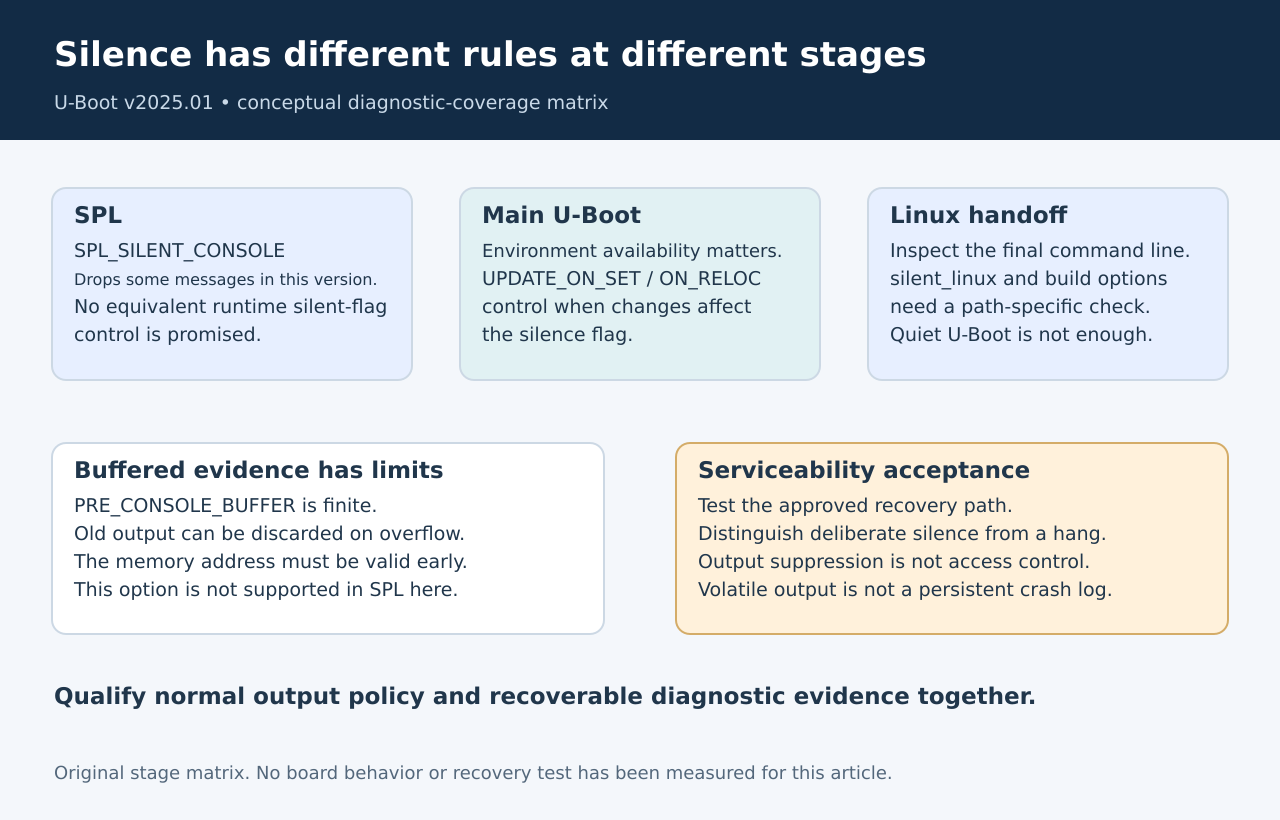
Kconfig definitions document SILENT_CONSOLE for main U-Boot and a
separate SPL_SILENT_CONSOLE behavior. In this version, the SPL option
drops some messages and does not provide the same runtime silent-flag
control. It is not a guarantee that all SPL output disappears.
Check when the
environment change takes effect
Main U-Boot’s silence behavior depends on more than whether a saved
environment contains a variable. Inspect SILENT_CONSOLE_UPDATE_ON_SET
and SILENT_CONSOLE_UPDATE_ON_RELOC in the actual configuration, then
identify when the environment becomes available on this board.
The tagged
console callback checks those update options and distinguishes
interactive changes from other environment updates. It sets or clears
the silence flag according to the callback value. This gives a concrete
explanation for why changing the variable at a prompt and loading the
environment during startup need not produce identical timing.
A useful transcript records the compiled options, the environment’s
source, the point at which it was loaded and the mechanism used to
change it. Do not infer the earlier console state from a variable
printed after boot. A later correct value cannot reconstruct messages
that were already discarded or emitted.
Keep runtime experiments separate from persistence. First validate
the behavior in a recoverable session. If the final product
intentionally persists a setting, qualify the next cold start as its own
case. A change that appears reversible at a visible prompt can make a
subsequent boot harder to diagnose.
Keep Linux console policy
explicit
The environment
reference describes silent_linux and its relationship to Linux’s
console argument. The console configuration also provides
SILENT_U_BOOT_ONLY, intended to avoid silencing Linux along with U-Boot.
Check the selected combination and the actual boot path rather than
assuming that a quiet bootloader implies a quiet kernel, or the
reverse.
Inspect the final command line handed to the operating system. Other
script or board logic may contribute arguments, and a setting that
exists in the environment is not proof that a particular boot path
consumed it. Record normal boot and recovery boot separately when they
construct their arguments differently.
This is an observability decision, not an access-control guarantee.
Suppressed output does not establish that input, an interactive prompt
or a recovery mechanism is disabled. If the product has security
requirements for those interfaces, test those requirements independently
instead of using a quiet UART as the acceptance criterion.
Decide whether
buffering actually helps
The same Kconfig file describes a pre-console buffer for output
generated before console initialization. It has a finite capacity, can
discard older output on overflow and is not supported in SPL by that
option in this version. Its memory location must be valid when accessed.
Enabling it without a memory-layout review can introduce a new
early-boot problem.
Treat a buffer as an evidence path with its own lifetime. Decide who
retrieves it, how the release identifies overflow and whether reset
destroys the information. Do not describe a volatile buffer as a
persistent crash log. If the failure occurs before the buffer is usable,
it will not answer that earlier question.
Test silence and
serviceability together
A proposed matrix includes an environment with and without the
silence setting, an interactive change when supported, a fresh boot
loading persistent settings and an early failure before normal handoff.
Add the product’s supported recovery entry and a case that exercises
Linux console policy. State the expected output for each stage before
observing the device.
Use short, recognizable diagnostic markers in a qualification build
to determine which stage produced each line. Then repeat the relevant
checks with the intended release configuration. If buffering or logging
changes timing, retain that difference in the report rather than
claiming equivalence without evidence.
A successful quiet-boot design has two demonstrated properties:
routine output follows the intended stage-specific policy, and the
approved service path still yields the evidence needed to diagnose a
failed boot. The configuration names are the starting point. The release
contract is the observed behavior of the complete, versioned boot
path.