Buildroot Git LFS Sources: Diagnose Pointer Files Before Debugging a Broken Asset
When a Buildroot package receives a tiny text file where a binary asset should be, inspect whether the file is an unresolved Git LFS pointer before investigating the asset decoder. A checkout can identify the intended revision without containing every out-of-band object needed by the build. The useful question is whether the acquisition path materialized the required object into the source tree that was archived.
This guide pins Buildroot 2026.08. The examples are hypothetical and the retrieval checks are proposed, not executed. It addresses LFS materialization rather than general source-tarball reproducibility, permission to redistribute assets or the quality of a firmware image.
Identify the placeholder without trusting its filename
A filename ending in a familiar binary extension does not establish its representation. The Git LFS pointer specification describes a small text representation carrying a format identifier, object identifier and size. That text identifies another object; it is not the original image, model or other asset merely because it occupies the same pathname.
For a suspected asset, inspect a safe local copy, record its actual byte count and compare its structure with the pointer specification. Do not paste private asset content into a public diagnostic service. A pointer classification narrows the failure to source preparation; it does not prove that the referenced object is accessible or that its content is suitable for the product.
A hypothetical package embeds a display bitmap. The image generator reports an invalid header, while the input file is only a few lines of LFS metadata. Changing the bitmap parser would address the wrong boundary. First establish how those lines reached the extracted package directory.
Check the Buildroot acquisition method
The 2026.08 package manual specifies the package GIT_LFS setting for repositories using LFS, and limits it to Git acquisition. An ordinary hosting-service archive URL is a different download route. Do not assume a setting intended for the Git backend changes the contents of an independently supplied HTTP archive.
Inspect the resolved recipe rather than a copied fragment: package version, site, method and LFS setting. Determine whether the source used in this attempt came from an existing download artifact, a mirror or a newly generated Git archive. Preserve the failing artifact for comparison rather than overwriting it during diagnosis.
Separate downloading from populating the working tree
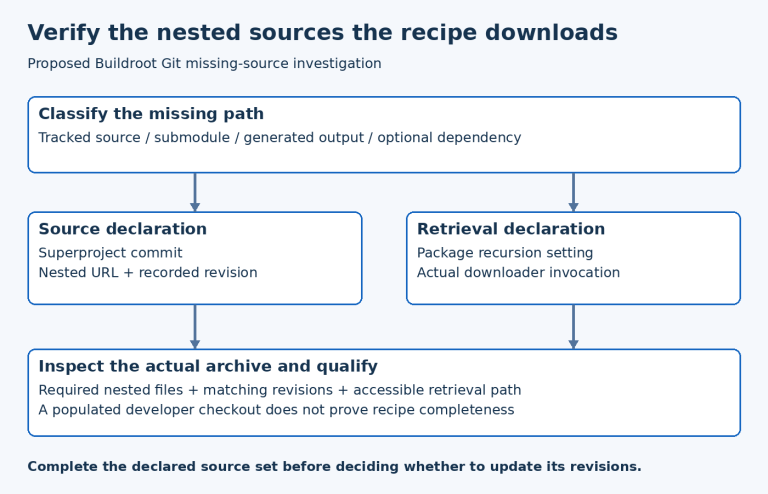
The tagged Git backend has an LFS-enabled branch that installs local LFS handling, fetches objects and checks them out before archive generation. With recursive submodules enabled, it also invokes corresponding LFS operations within those submodules. This is explicit preparation, not a consequence of merely resolving a commit.
The Git LFS checkout reference says checkout uses object data already available locally; downloading is a separate responsibility. Therefore, “checkout ran” is weaker evidence than “the required object was available and the expected working-tree file contains its bytes.” Inspect the actual stage that failed instead of repeating only the final command.
Test the consumer's input, not a developer's warm checkout
Use an isolated, authorized source-download area for a proposed reproduction. Record whether access to both repository content and required LFS objects succeeds. Keep credentials out of logs and never resolve an access problem by copying secrets into package metadata.
Then inspect the resulting archive and the extracted package file. Compare expected representation, size and permitted integrity evidence at those boundaries. A developer's already-populated checkout is not a control for an independent builder with an empty object store.
Include one deliberately unavailable test object in a disposable fixture if the repository and access policy permit it. The expected product behavior is a visible preparation failure or an explicitly rejected incomplete input, not silently packaging pointer text as a valid asset. Actual tool outcomes need to be observed before claiming that gate works.
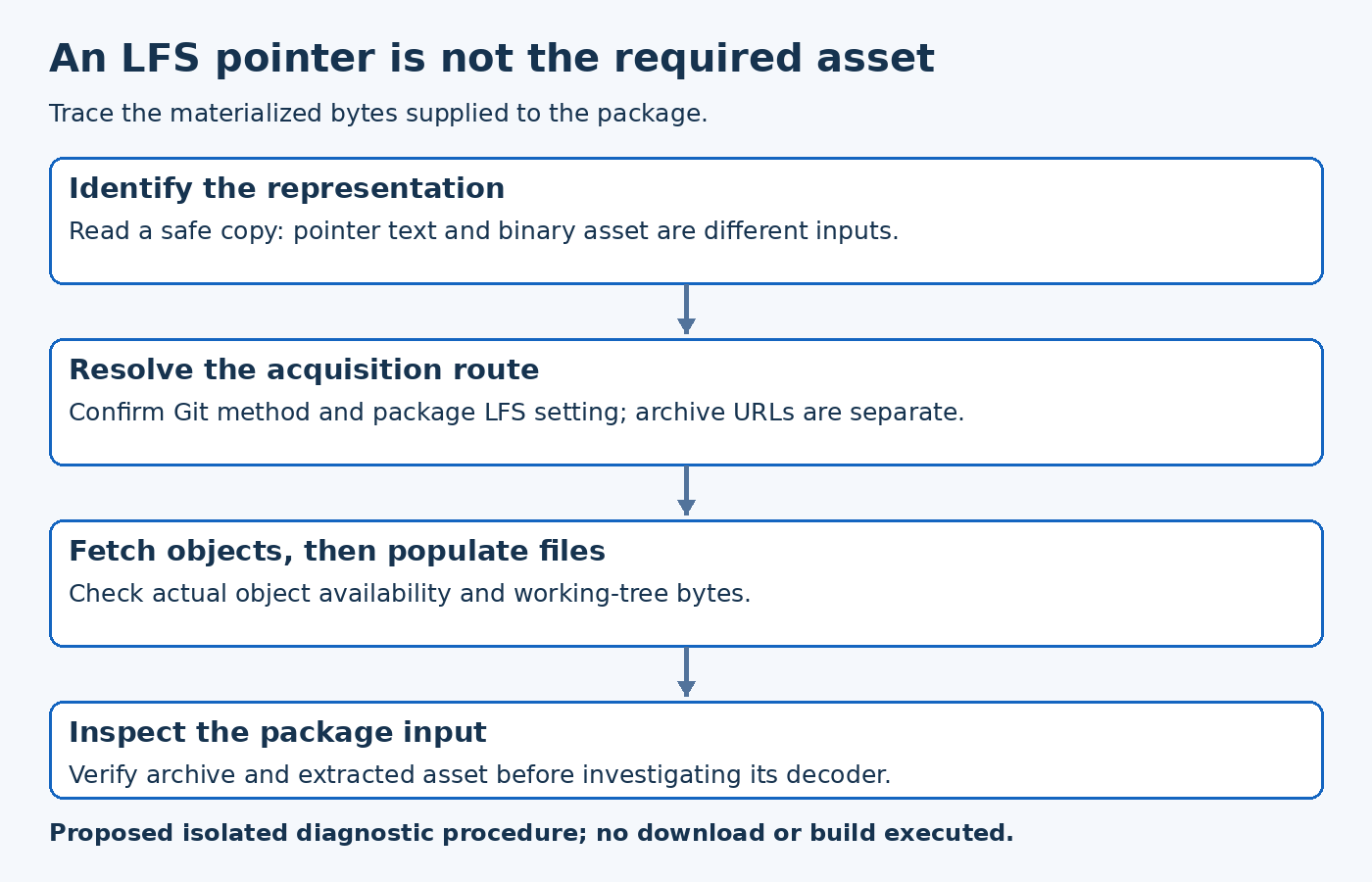
The practical result is a short diagnosis chain: identify the pointer, verify the selected acquisition path, locate object retrieval and materialization, then inspect the bytes supplied to the package. Keep asset parsing changes out of that chain until the input is genuinely the intended asset.