Zephyr OS Socket Offload: Qualify the Operations Your Application Actually Uses
A successful socket() call proves that a provider accepted a family, type and protocol request. It does not prove that every later operation required by the application is implemented or behaves identically across native and offloaded providers. Qualify the application's real socket contract before replacing one connectivity backend with another.
This review uses Zephyr 4.4.0 dispatch and offload interfaces. It is not a compatibility claim for a particular modem or network module. Provider-specific behavior and firmware versions remain part of the qualification target.
Identify the selected provider boundary
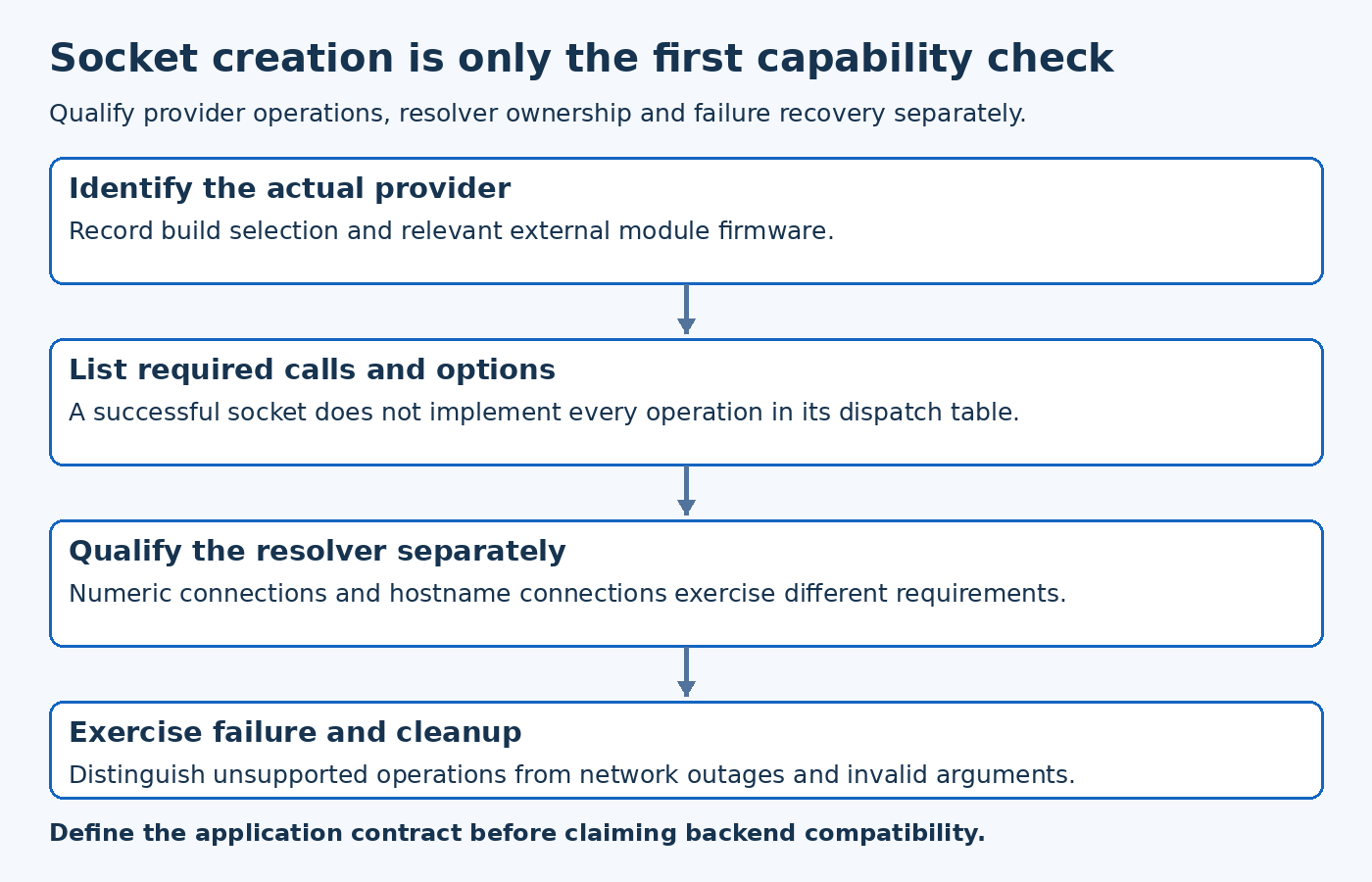
The tagged socket dispatch implementation walks registered socket providers, checks family and the provider's support predicate, and calls the selected handler. Later operations use a socket operation table. Missing entries in the common dispatch macro return -1 with errno set to EOPNOTSUPP; the separately implemented shutdown path returns -1 with errno set to ENOTSUP when its operation is absent.
This is a reason to test capabilities at the operation level. A hypothetical client can create and connect a socket successfully but fail later when its library requests an option, a shutdown behavior, or another operation the selected provider does not support. The initial connection demonstration did not exercise that requirement.
Record the backend selected by the build and configuration, along with the module firmware where relevant. Do not label a result simply “Zephyr sockets passed” when the actual provider is part of what made it pass. Likewise, an unsupported-operation result should not automatically be diagnosed as a transient network outage.
Derive a contract from the application, not from a generic API list
List the calls and options used on the normal path, error path and reconnect path. Include the actual address families, socket types, protocol values, timeout choices and nonblocking behavior the application depends on. Review library code as well as direct calls in the application.
For each requirement, define an observable outcome. A timeout requirement needs a bounded return behavior; a reconnect requirement needs resources released sufficiently to open a replacement connection. A feature that is never used by the product need not block migration, while an obscure cleanup operation can be essential if the library calls it after every failure.
Keep intentional fallbacks explicit. If the application can tolerate an unsupported optional setting, record why. Do not ignore all option failures as a shortcut, because a mandatory security or liveness setting may be among them.
Treat name resolution as its own offload boundary
The tagged socket offload interface exposes a separate DNS offload interface with getaddrinfo and freeaddrinfo operations, registration, and runtime enable or disable control. Socket transport support alone therefore does not describe the entire name-resolution path.
Test a numeric destination and a hostname separately. If the numeric connection succeeds while the hostname path fails, investigate resolution ownership, configuration and returned data rather than immediately changing transport retry timing.
Keep result allocation and release paired according to the selected API contract. Do not assume a structure produced by one resolver path can be released through an unrelated provider's mechanism. Provider transitions and runtime configuration changes need review where the product supports them.
Exercise cleanup and failure, not only a successful exchange
Use controlled tests for failed connection, peer close, timeout, reconnect, and resource exhaustion at the limits the product expects. Capture the specific failing operation and error code. Distinguish an operation that is absent from one that is implemented but rejects a particular argument or state.
Avoid claiming that a matching function name guarantees matching edge behavior. Verify the semantics needed by the application and document any backend-specific limitation at the integration boundary. A thin adapter may make the supported subset clearer, but it should not fabricate success for an operation that was never performed.
The migration is ready when the selected provider satisfies the product's explicit call and failure-handling contract. That is more useful evidence than a one-message socket demonstration and prevents late discovery of an unsupported operation in a rarely exercised recovery path.