Industrial Diagnostic Files: Design the Capture-to-Analysis Path Alongside Telemetry
A machine's trend values and its diagnostic files solve different problems. A few vibration indicators may support continuous monitoring, while a captured waveform, inspection image or compressed log needs a separate path to storage and analysis. An industrial IoT proposal should describe both paths before promising that remote engineers can investigate an incident.
Start with the evidence a reviewer actually needs. File transfer alone does not establish which machine produced a capture, what operating condition it represents, or whether the analysis service can interpret it. These requirements influence the device software, storage organization and backend work together.
Give each capture a useful identity
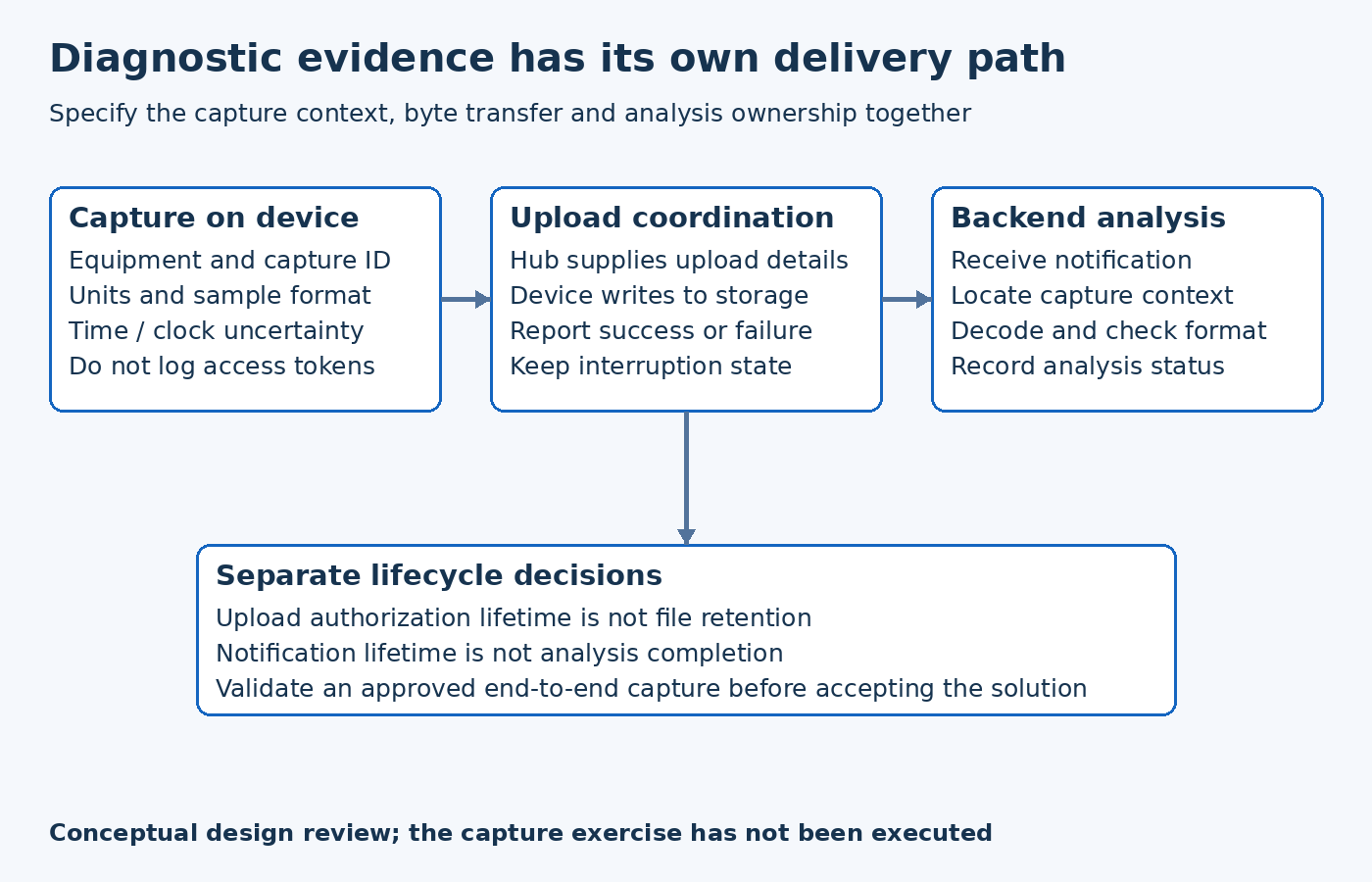
For a hypothetical vibration investigation, define a capture identifier, equipment identifier, channel descriptions, units, sample rate, acquisition interval and processing version. Record whether the waveform contains raw samples or an already transformed representation. This is a proposed information contract, not a claim about a deployed monitoring system.
Keep acquisition time separate from upload and analysis time. If the device cannot establish a trustworthy clock, preserve the uncertainty rather than inventing a precise timestamp. A late-arriving file may still be valuable, but it should not silently appear to describe the machine's current state.
Choose a naming policy that avoids replacing an earlier capture accidentally. Decide whether metadata travels inside the file, alongside it, or through a linked application record. The important requirement is that the analyst can recover the relationship without relying on the current gateway configuration.
Trace where the file actually travels
Azure IoT Hub's file-upload reference illustrates why this needs its own design. The hub supplies a per-upload storage URI and correlation identifier. The device transfers bytes directly to Azure Blob Storage, then reports success or failure to the hub. Optional backend notifications provide another integration step. Finishing the storage transfer is therefore not the same as finishing analysis.
Map these participants in the proposed installation. Include device-to-storage connectivity as well as device-to-hub connectivity. A telemetry demonstration that only exercises the hub does not demonstrate that a large capture can reach its destination through the site's approved network path.
Separate access duration from evidence retention
Microsoft's configuration guide treats upload authorization lifetime and file-notification lifetime as separate settings. It also distinguishes the hub's authentication to storage from the device's use of the supplied storage URI. Do not describe one identity setting as replacing every credential in the flow.
For the project specification, distinguish three decisions: how long an upload may run, how long a downstream notification remains useful, and how long the actual diagnostic evidence should be retained. The third is an application and storage policy decision, not a consequence of choosing a short-lived upload authorization.
Keep access-bearing URLs out of ordinary incident notes and screenshots. Share a capture identifier and an approved retrieval route with support staff instead. Review whether files contain production recipes, personal images or proprietary process details before defining who may retrieve them.
Plan incomplete transfers and incomplete analysis separately
The IoT Hub reference requires reporting unsuccessful uploads too; completion reporting releases upload resources, otherwise they remain until the authorization lifetime expires. Design the device's recovery record around the real SDK behavior and the interrupted stage.
At the application level, distinguish capture unavailable, transfer incomplete, stored but unprocessed, rejected format and analysis complete. These states answer different operational questions. If a backend parser rejects a file, uploading the same bytes repeatedly is unlikely to repair the format mismatch.
A representative acceptance exercise should capture a known signal, interrupt one transfer, restore connectivity, and confirm that the intended analysis can identify the equipment and decode the data. Compare the expected metadata and sample representation with what the analyst actually receives. Treat this as a proposed exercise requiring an approved test setup, not as an executed result.
The useful deliverable is a complete diagnostic path with clear ownership of acquisition, transfer, storage and interpretation. Continuous telemetry can point to an incident; the file workflow must preserve enough context to investigate it.