Changing a Node-RED MQTT Connection: Find Every Flow That Shares It
Before changing a broker endpoint or another shared MQTT setting in Node-RED, identify every flow node that uses the same configuration node. The selected canvas node is only the entry point to the editor dialog; it does not necessarily define the scope of the change.
A hypothetical gateway may have separate tabs for equipment telemetry, production reporting and maintenance diagnostics. If all three reference the same broker configuration, a connection change needs a review across those consumers even when the engineer opened the dialog from just one MQTT Out node.
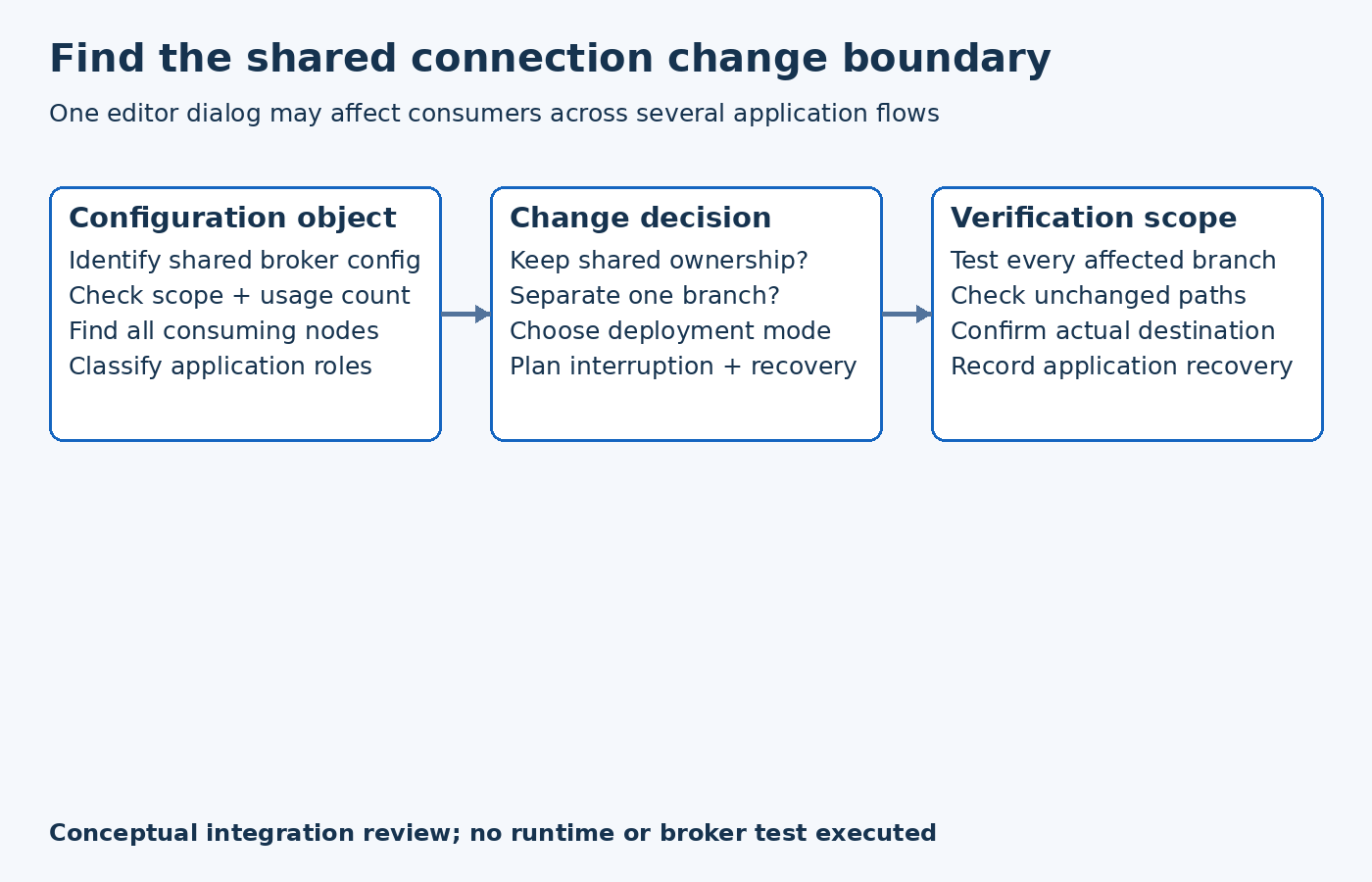
Follow configuration references, not visual proximity
The official Node-RED node guide explains that MQTT In and Out nodes use a broker configuration node representing a shared connection. Configuration scope controls where it is available, and its edit dialog reports how many nodes use it.
Use the configuration-node sidebar to inspect the relevant configuration and usage count. Then identify the actual consuming nodes and their business purpose. A count is a starting point for the dependency review, not a substitute for knowing whether a consumer is a telemetry reader, a command publisher or a diagnostic branch.
Record the configuration identity alongside the endpoint and the intended change. Similar labels are not enough to distinguish two configuration objects, and different canvas labels do not prove that the underlying connections are independent.
Decide whether sharing still matches the application boundary
Shared configuration can be appropriate when several flows intentionally use the same broker identity and connection lifecycle. It becomes a problem when one application needs an independent maintenance window or a different destination but still shares the old object by accident.
Do not duplicate configuration reflexively. Separate connections also require deliberate client identities, permissions and operational ownership. If isolation is needed, design and test the new boundary explicitly rather than treating a copied node as proof that isolation has been achieved.
For the hypothetical gateway, the maintenance branch might need a test broker while production telemetry remains on the plant broker. The change review should say whether to reassign that branch to a distinct configuration or move all consumers together. That decision belongs before activation.
Include deployment mode in the interruption plan
The official deployment API contract distinguishes full, modified-node, modified-flow and reload deployment modes. Full deployment stops existing nodes before starting the new configuration; narrower modes have narrower documented restart scopes. The mode is therefore part of the operational change, not merely a preference for how quickly the editor responds.
A mode name alone should not be used to promise that an affected MQTT connection will remain uninterrupted. The shared dependency, actual changed objects and installed runtime behavior still need verification. Describe the expected interruption and recovery for every affected application path.
If an external deployment client is used, keep its revision handling and authorization within the approved process. This article does not provide a force-deploy shortcut or suggest bypassing a conflicting revision to make a change succeed.
Verify consumers before closing the change
Prepare an isolated version of the actual shared layout. Change the intended configuration using the chosen deployment method, then observe each listed consumer. Check both its connection state and a harmless application-level input or output appropriate to that branch.
Include the path that was supposed to remain unchanged. A successful publication from the edited branch does not prove that another tab still receives its measurements. Likewise, reconnecting all nodes does not establish that their destination policy is correct.
This verification has not been executed here. For the real maintenance operation, retain the affected-node list, chosen deployment scope and observed recovery result. Those records explain why a shared connection was safe to change and make the next engineer less likely to confuse one visible node with one isolated application.