Zephyr OS Network Buffer Clones: Check Whether Payload Storage Is Shared or Copied
A cloned network-buffer object is not necessarily a private copy of its payload. In Zephyr OS, the allocation strategy influences whether net_buf_clone shares the underlying bytes or allocates separate storage. Code that edits a clone can therefore behave differently after a pool configuration change, even when the calling code remains unchanged.
This article follows Zephyr v4.4.0 buffer allocation and cloning. It proposes a review for applications that duplicate buffers for logging, protocol processing or multiple consumers. It does not report executed concurrency tests or assume that any particular subsystem permits application modification of its buffers.
Inspect the allocator behind the clone
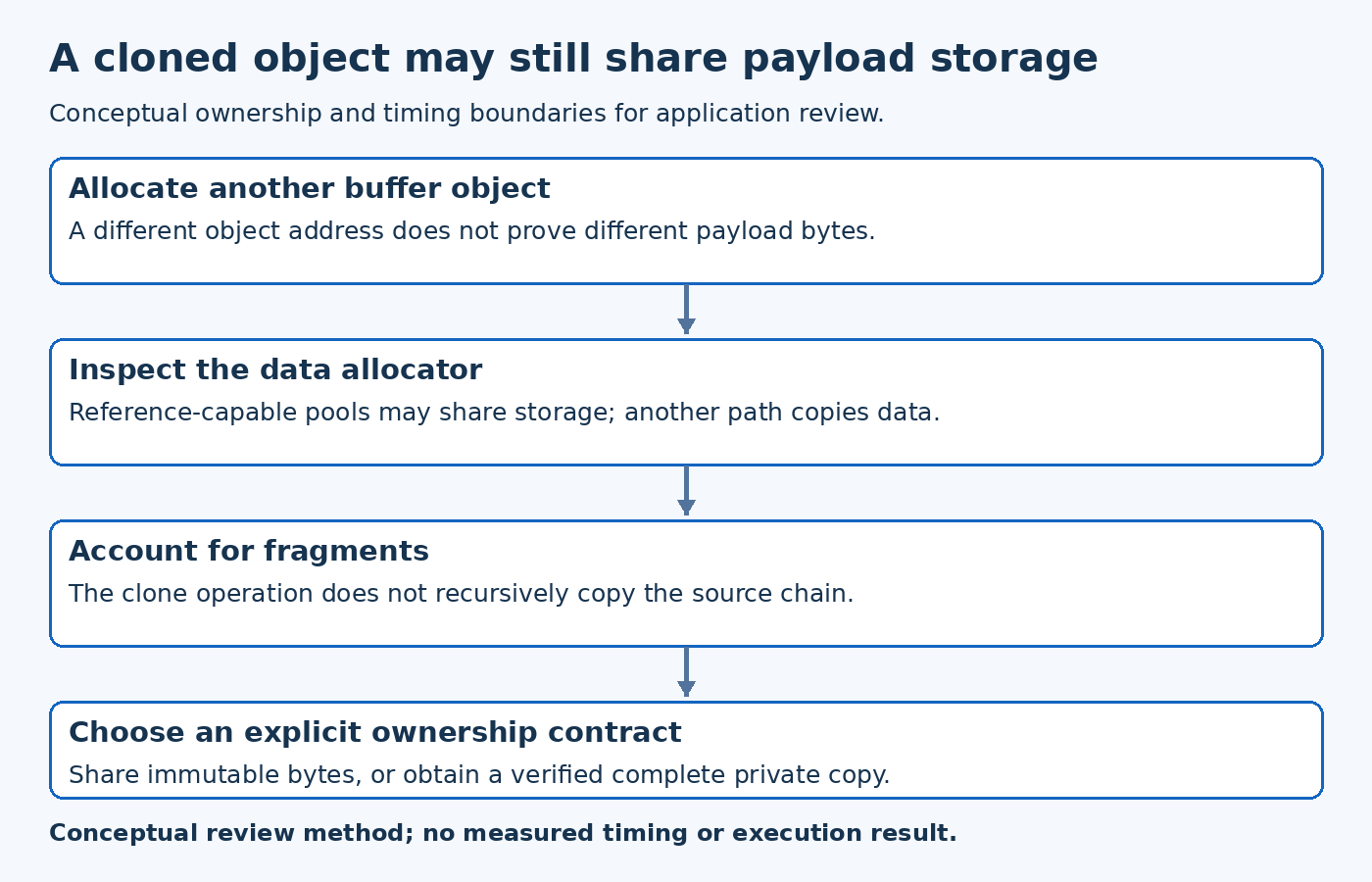
The versioned buffer implementation first allocates a new buffer object. When the pool supports data referencing and the original does not use external data, it references the existing payload storage. Otherwise it allocates storage and copies the current data. It also copies user data. The new object begins without a fragment chain; this function does not recursively duplicate the source chain.
Consequently, separate object addresses do not establish separate payload addresses. Inspect the actual pool and its data callbacks when deciding whether modification is permitted. Do not base an ownership contract on behavior observed only with a different test pool.
The public buffer header also exposes net_buf_simple_clone, a separate operation explicitly intended to share the backing data while allowing independent cursor state. Keep these interfaces distinct in wrappers and reviews. Neither a similar name nor a new cursor establishes a deep packet copy.
Separate cursor edits from byte edits
Advancing a private cursor can let a parser inspect a message without changing another object's current offset. That is useful when two consumers need different views of the same immutable bytes. Writing through the resulting data pointer is a different action: where storage is shared, the write changes what the other view can observe.
Consider a hypothetical diagnostic consumer that clones a buffer and replaces a sensitive field with asterisks before logging it. If the pool shares payload storage, that redaction can also alter bytes still needed by the protocol consumer. A diagnostic copy intended for editing should instead obtain deliberately private storage for the required data and verify that the complete copy succeeded.
Conversely, sharing immutable data can be a valid efficiency choice. State that immutability requirement explicitly and retain the necessary lifetime ownership until every reader is finished. A reference prevents premature reclamation under the interface's ownership rules; it does not provide mutual exclusion for concurrent payload edits.
Do not lose the rest of a fragmented message
A packet may span a chain, while a clone operation concerns one buffer. Before using the result as a complete message, determine whether the source has fragments and what the downstream consumer expects. Copying only the first fragment can appear correct for short messages and fail only when the payload crosses the pool's buffer size.
Choose a separate, deliberate chain-copy or linearization design when the consumer requires the whole message. Preserve total-length checks and allocation failures. Do not attach the original fragments to another owner without understanding reference transfer and teardown behavior.
This is also relevant to tests: a fixture whose messages always fit in one buffer will not expose a missing-chain assumption. Include a message that crosses at least one fragment boundary and inspect the exact bytes delivered to each consumer.
Qualify the intended sharing contract
A proposed software test should cover the actual production allocator, not just a convenient fixed-size test pool. Compare object and payload identities, exercise independent cursor movement, and verify that any intended private editable copy cannot change the original. Keep failure paths bounded when clone allocation is unavailable.
For immutable sharing, test both consumer completion orders and ensure that neither accesses the payload after releasing its ownership. For private copying, verify complete content across fragmentation before publication. These tests establish the chosen ownership contract; they do not turn every clone into a deep copy by assumption.