Yocto SPDX Output: Diagnose Missing Documents and Source Archives
Inspect Yocto create-spdx output families, distinguish optional source and package archives, and diagnose missing documents, namespace mismatches, and broken SPDX relationships.
Board-level Linux integration, U-Boot, device trees, kernel drivers and peripheral bring-up. Separate power and hardware checks from software adaptation, and define a recoverable boot path.
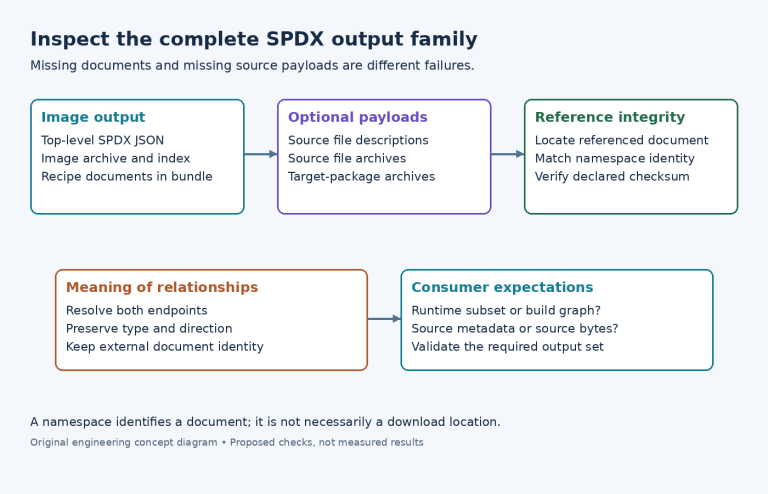
Inspect Yocto create-spdx output families, distinguish optional source and package archives, and diagnose missing documents, namespace mismatches, and broken SPDX relationships.
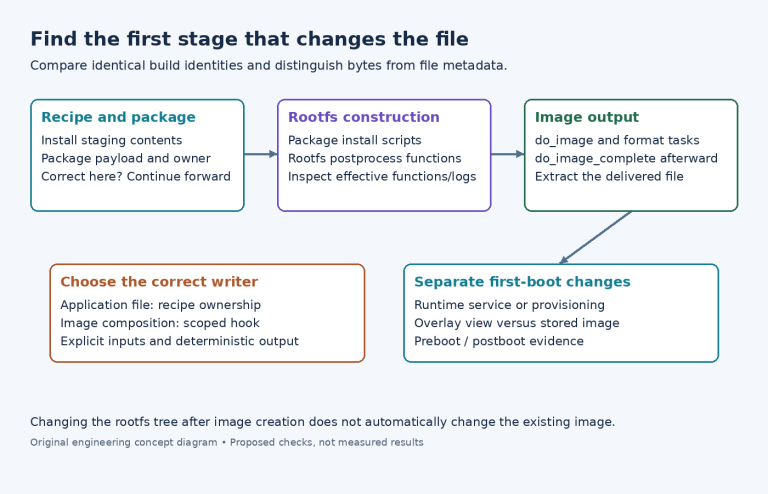
Trace a changed Yocto image file across package payload, rootfs postprocessing, image generation, and first boot to identify its actual writer and ordering.
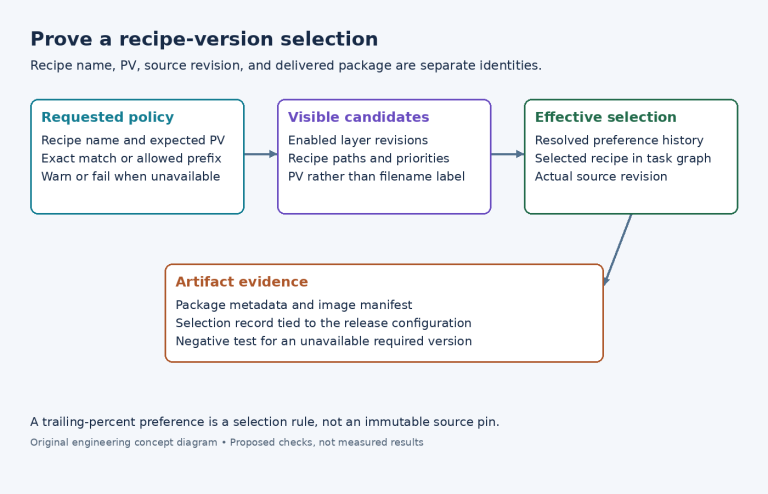
Diagnose Yocto version selection by matching PV, inspecting visible recipes and layer precedence, choosing warning versus required-version failure, and tracing the selected artifact.
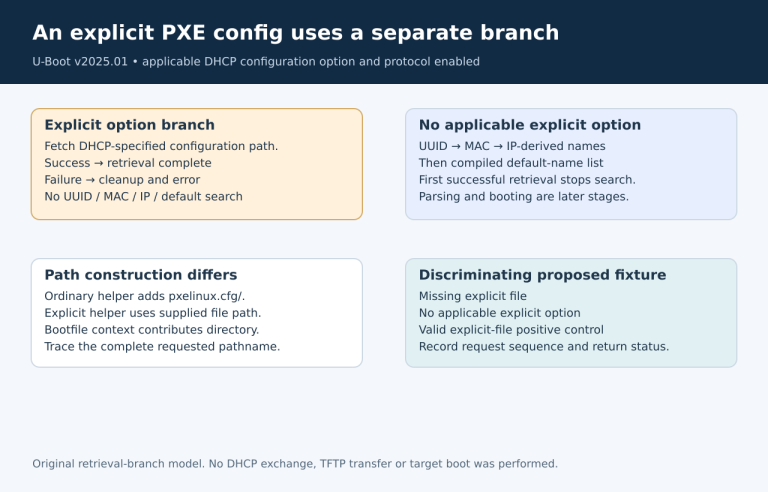
Diagnose the explicit DHCP config branch before assuming PXE will search UUID, MAC, IP and defaults after a missing file.
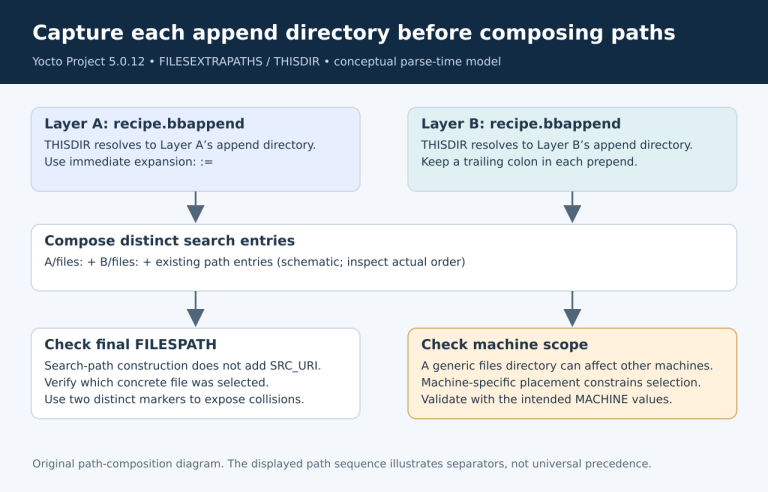
Inspect parse-time directory capture, path separators and machine-specific file selection with two append files.
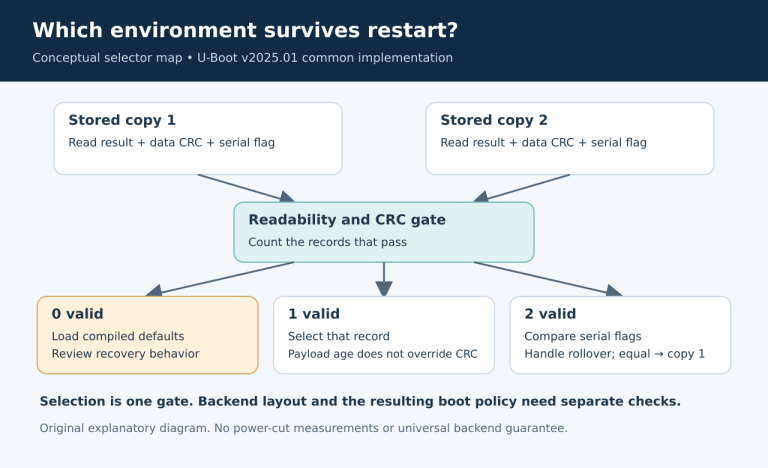
Trace the tagged loader’s read, CRC and serial gates, then qualify the actual storage layout and recovery defaults.
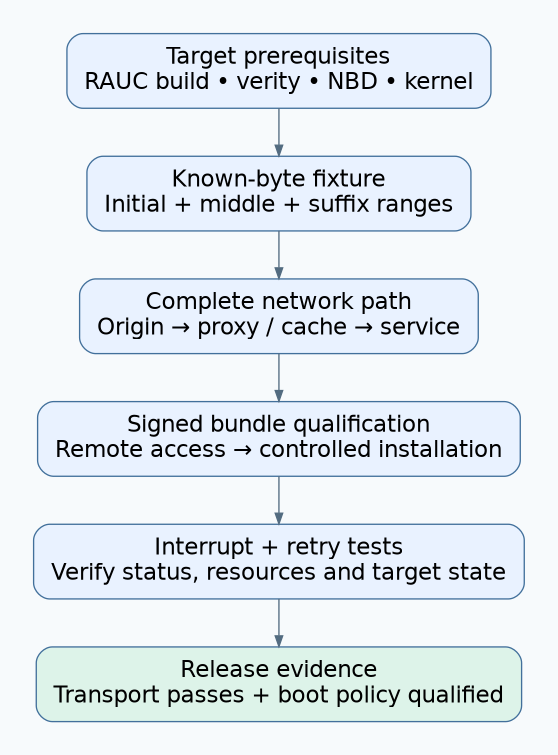
RAUC HTTP streaming requires a compatible bundle, the necessary target kernel support, and working byte-range access through the complete network path. Prove those prerequisites before comparing installation time or removing local staging capacity. A browser downloading the whole bundle successfully does not exercise the access pattern that streaming installation needs. This guide is pinned to…
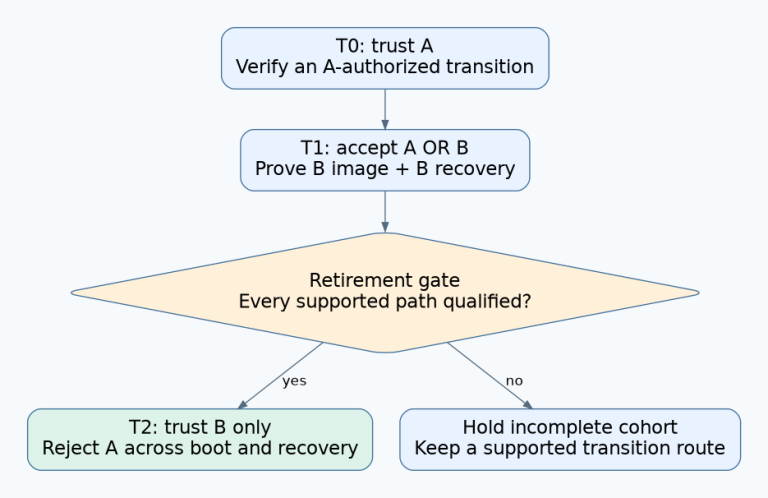
Retire a firmware signing key only after every supported boot and recovery path can authenticate an approved replacement image without that key. For a planned rotation, an explicitly qualified overlap state can let devices accept both the old and new signer while the fleet migrates. That overlap is a product-specific trust policy, not a universal…
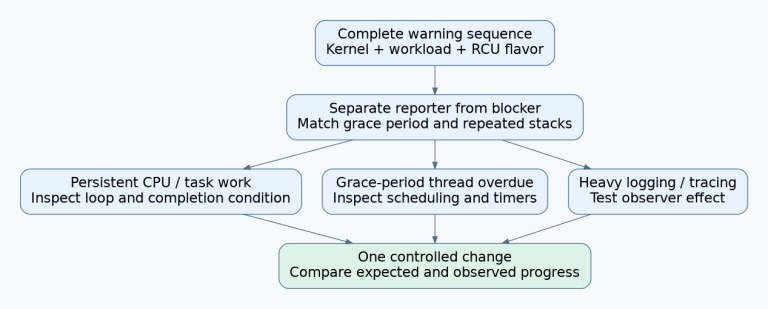
An RCU stall warning means required RCU progress is overdue; it does not identify the root cause by itself. Start by separating the CPU that printed the warning from the CPUs or tasks reported as stalled. Then compare repeated observations from the same grace period, inspect scheduler availability, and test whether logging itself contributes to…
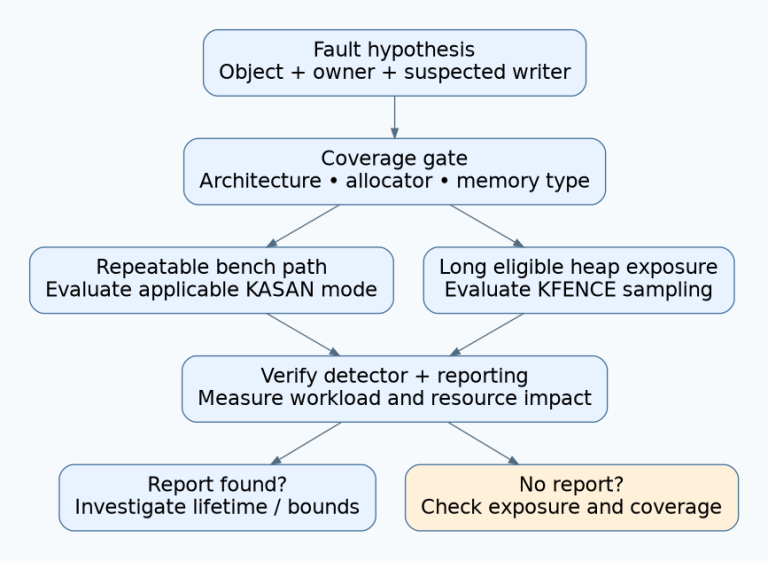
Start with KASAN for a reproducible kernel memory-access bug when the test image can tolerate its chosen mode; consider KFENCE for longer-running sampling when production-like behavior matters. This is a test-planning decision, not a universal ranking. The right detector must cover the suspected allocation, run on the actual architecture, and preserve enough workload exposure to…