Y2038 Qualification for 32-Bit Linux Devices: Test Stored Dates and Protocol Fields Beyond time_t
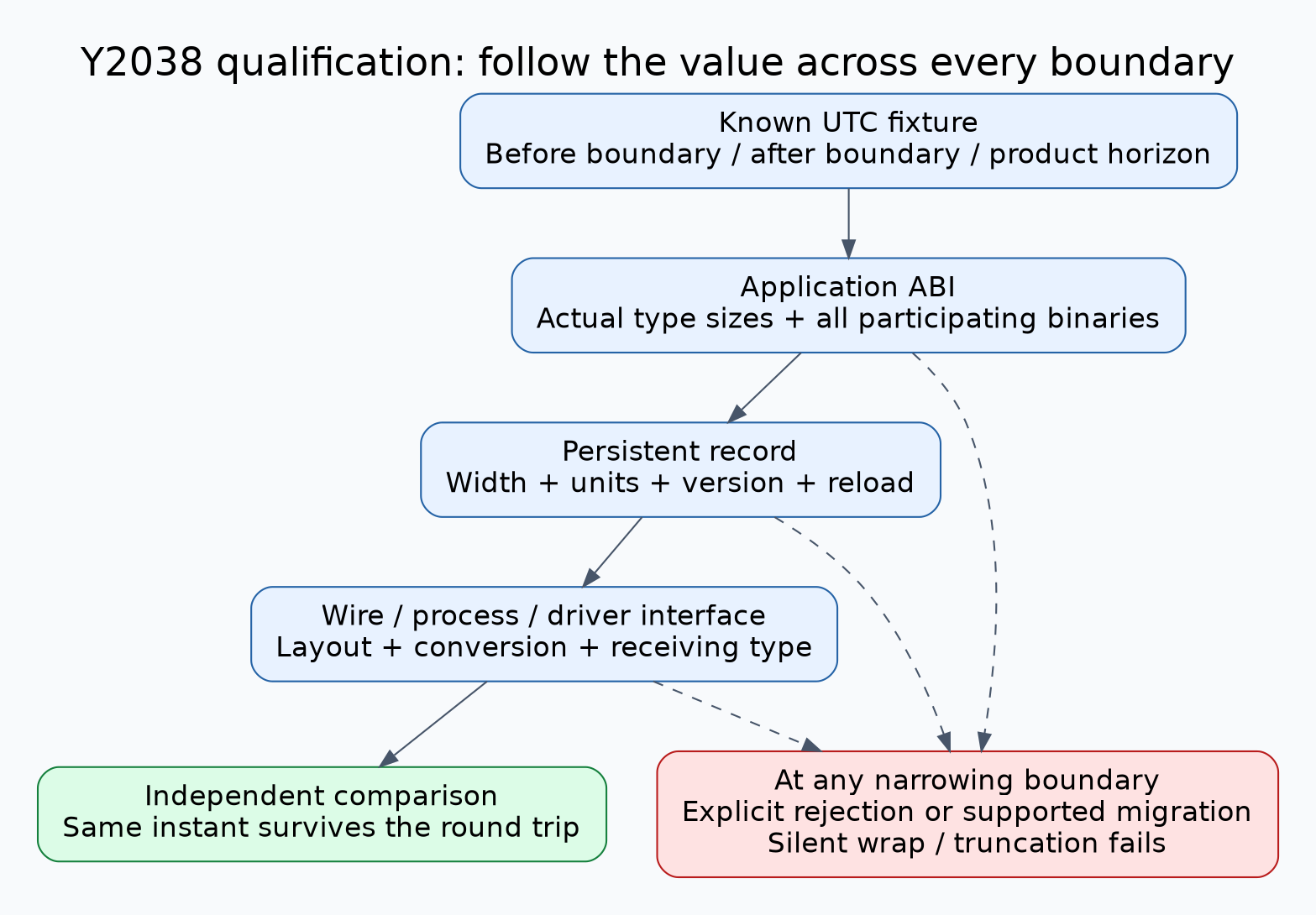
A 64-bit time_t is a necessary interface choice for many long-lived 32-bit Linux applications, but it is not an end-to-end Y2038 qualification. A saved record, driver interface, protocol field or older helper process can still narrow the timestamp. Follow a future date through every conversion and prove that the same instant survives a complete round trip.
This guide uses GNU C Library 2.42 and Linux 6.6 documentation as explicit reference boundaries. The workflow applies to a selected 32-bit Linux product build; it does not claim that every libc, ABI, filesystem or vendor kernel behaves identically. Record the actual compiler, libc, kernel, root filesystem and firmware identities before running the proposed target tests.
Define the horizon and timestamp meaning
Choose the latest date the product must represent, not just the expected retirement date. A device may create a maintenance deadline or validity interval years into the future while operating today. Inventory both received timestamps and future dates calculated locally.
For signed 32-bit POSIX seconds, 2,147,483,647 corresponds to 2038-01-19 03:14:07 UTC; the next second cannot fit. Linux’s time(2) documentation, man-pages 6.19 identifies the following second as the relevant representability boundary for a 32-bit time_t executable. Do not interpret that as a promise that every failing path reports the same error.
Write down the epoch, unit, signedness and valid range for every field. A value described only as “timestamp” is an incomplete contract. Seconds and milliseconds have different ranges; monotonic elapsed time and calendar time have different meanings. Keep this investigation focused on representability and serialization, rather than changing timezone rules or clock synchronization policy.
Prove the ABI of every participating component
The glibc 2.42 manual states that _TIME_BITS controls time_t and related types and function declarations. Selecting 64 requires _FILE_OFFSET_BITS=64. Defaults remain architecture-dependent, so a build should not infer its time width from the CPU’s marketing name. See glibc 2.42 feature-test macros.
Check the macros before system headers are included, the effective compiler command, and the generated type sizes in the actual target build. Extend that check to plugins, static libraries, shared libraries and small helper programs. A successful build of the main executable says little about an older binary that still parses dates or reads shared data.
Where components exchange structures containing time_t, compare the field sizes, offsets and total structure layout on both sides. Rebuild compatible participants together or introduce an explicitly versioned external representation. Avoid writing native structures directly to disk as a migration shortcut: changing the source type can change both field width and layout.
The versioned glibc time-type reference also distinguishes calendar-time types from processor-time counts. Use that distinction when reviewing similarly named fields; widening the wrong timer does not qualify a stored calendar date.
Inventory the boundaries that can narrow time
- Persistent records: configuration blobs, event journals, local database columns, exported files and update-state records. Inspect actual serialized bytes or schema definitions.
- Application protocols: binary fields, text-to-integer parsers, gateway conversions and the remote receiver’s destination type. A decimal string can still be narrowed during parsing.
- Process boundaries: shared-memory layouts, local RPC, helper utilities and language bindings. Check both producer and consumer versions.
- Kernel and device boundaries: custom ioctls, RTC paths and vendor drivers. Confirm the precise interface and its supported range.
- Derived values: expiry calculations, sorting keys, subtraction and unit conversion. Check intermediate expressions, not only the final storage type.
Linux 6.6’s ioctl interface guidance specifically warns about incompatible timespec and timeval definitions after the move to 64-bit time_t. It recommends carefully defined layouts and discusses fixed-width fields and compatibility handling. A user-space type change therefore cannot, by itself, repair a private driver ABI.
For each boundary, record the writer, reader, version, representation, maximum supported value and failure behavior. Mark unknowns explicitly. “The database supports large integers” is not sufficient if the binding converts the value through a smaller application type before insertion.
Use a boundary corpus with clear pass conditions
Begin with injected values in unit and integration tests, without changing the machine’s real clock. A useful starting corpus contains 2038-01-19 03:14:06 UTC, 03:14:07 UTC and 03:14:08 UTC, followed by 2040-01-01 00:00:00 UTC and the product’s declared maximum date. Include pre-epoch values only if the product claims to support them.
The first four example labels have been checked by UTC arithmetic; that check is not a test of any embedded target. The proposed qualification is:
- Parse each input through the production parser and compare it with an independently prepared expected value.
- Pass it through the real library and process interfaces. Check both returned values and documented errors.
- Persist it, restart the consuming process, reload it and compare the exact instant and subsecond portion where applicable.
- Transmit it through the real encoder, gateway and decoder; inspect both the wire representation and the receiver’s value.
- Exercise range endpoints and out-of-range inputs. Require explicit rejection or a documented compatible representation; silent wrap, truncation or clamping fails.
- Test arithmetic that crosses the boundary, including adding a future validity interval and comparing records on opposite sides of it.
Do not limit the oracle to a formatted date string. A display function and parser can share the same defect. Compare raw encoded values, declared units and the independent expected instant as well.
Test upgrade, reboot and rollback as separate readers
A migration is incomplete if the new firmware writes dates that its supported rollback image misreads. Define the compatibility policy before the first new-format write. Options might include retaining an old representation within its valid range, adding a new versioned record, or explicitly blocking a downgrade that cannot interpret the data. Choose according to the product’s approved update design.
Use disposable test storage and preserve the pre-migration image. Exercise old-record import, new-record creation, process restart, device reboot and each supported rollback path. Verify that an unsupported reader refuses the record clearly instead of assigning a plausible but wrong date.
Only after value-injection tests pass should an isolated target be tested with future wall-clock time, if that is needed for the product claim. Account for scheduled actions and remote services that could react to the clock change. Do not advance production devices or shared infrastructure merely to obtain a quick screenshot.
Hypothetical example: the application passes, the archive fails
Consider a hypothetical industrial recorder whose main application has a verified 64-bit time_t. Its archive format still stores event seconds in a signed 32-bit field, and a desktop export tool reads that field unchanged. Dates near the boundary display correctly until the application writes and reloads a post-boundary event.
The first failed gate is serialization, so replacing the kernel would not address this specific defect. A suitable investigation would define a new archive record version, update both device and export readers, and test mixed old/new archives plus the supported rollback policy. It would also check any index keys derived from the timestamp, rather than assuming the record payload is the only narrow field.
Close qualification with a boundary inventory and per-path results tied to build identities. “Uses 64-bit time” is a build property. “Preserves all supported dates across storage, communication and supported upgrades” is the stronger product claim that the evidence should establish.