Industrial Edge Connectivity: Review the Full Cloud Lifecycle Before Requesting Firewall Access
An industrial edge gateway can publish telemetry successfully and still fail its next software deployment. The network paths used for data exchange, credential retrieval and artifact downloads are not necessarily the same. Build a lifecycle-specific connectivity inventory before asking a site's network owner to approve access.
AWS IoT Greengrass V2 is the concrete example here. This is a planning and diagnostic method, not an instruction to weaken a firewall, bypass certificate validation or apply network changes without site authorization.
Separate runtime traffic from installation traffic
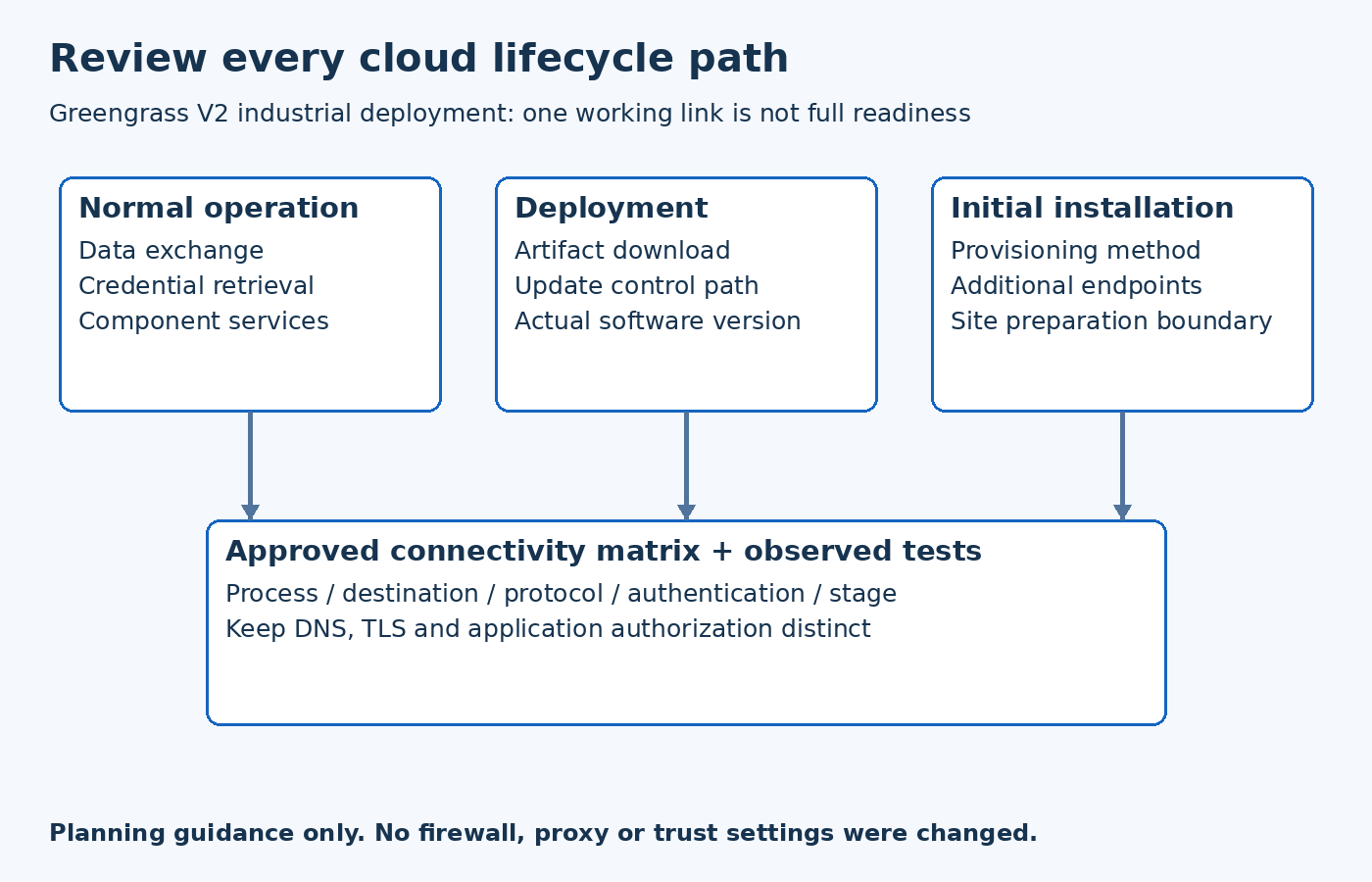
AWS's endpoint inventory distinguishes basic operation, automatic provisioning and component-specific dependencies. Basic operation includes separate data, credential and deployment-artifact paths. Automatic provisioning introduces additional service endpoints, while individual components may require their own destinations.
That distinction matters when a gateway is prepared in a workshop and delivered to a restricted plant. An already-provisioned unit can avoid some installation activity, but it still needs the operational paths used by its selected software. Conversely, demonstrating first installation on an unrestricted network proves little about a later update on the production network.
Create a row for each required operation: initial setup, routine data exchange, credential refresh, component download and each enabled component's external service. Name the initiating process, destination scope, transport, authentication approach and the stage in which access is needed.
Do not reduce the request to a port number
A statement such as “allow port 443” omits the destination and the protocol carried over that connection. The Greengrass core-configuration guide documents distinct MQTT and HTTPS arrangements, plus proxy-related version requirements. Check the exact nucleus version and configuration rather than assuming a port substitution preserves every authentication detail.
For a hypothetical factory pilot, suppose the gateway can reach its telemetry endpoint but cannot retrieve a component artifact. The observed failure is compatible with a deployment-path restriction; it does not prove that the whole cloud connection is broken or that application credentials should be replaced.
Keep DNS resolution, connection establishment, TLS validation and application authorization as separate observations. A failed TLS handshake should not be “fixed” by turning verification off. Ask the responsible owner to investigate the approved trust and proxy design.
Include the actual component behavior
Greengrass can pass proxy settings to components through conventional environment variables, but AWS notes that components must actually use them. A component that specifies its own values can also differ from the runtime's configuration. Review the application's network library and effective environment instead of assuming every process follows the same route.
Inventory component destinations from the vendor requirements and the approved application design. Avoid a blanket internet-access request merely because a component has not documented its dependencies. If an endpoint pattern is dynamic, explain the supported pattern and its purpose to the network owner instead of presenting a guessed fixed address as permanent.
Local field communication belongs in a different row from cloud access. A proxy intended for cloud traffic should not accidentally capture a local device path. Verify the intended local and remote boundaries without publishing real site hostnames or credentials in a public troubleshooting document.
Test the operations that will happen after handover
A proposed commissioning exercise should include a normal telemetry transfer, a permitted configuration or component update, and a restart under the approved site network policy. Use a harmless test component and a recoverable lab or pilot environment. Record which stage succeeds rather than treating one successful connection as evidence for all stages.
Also ask how a replacement gateway will be prepared. If automatic provisioning is deliberately excluded from the plant network, document the approved preparation process and the operations still required on site. This avoids discovering an installation-only dependency during an urgent replacement.
No network configuration was changed or connectivity test executed for this article. The outcome to seek is an approved, purpose-specific connectivity matrix and observed lifecycle tests. That gives the site team a bounded access request and gives the integration team a useful way to diagnose failures without weakening controls or blaming the wrong layer.