Planning a Legacy Linux BSP Migration to Buildroot LTS: Support, Patches and Scope
A legacy Linux device can keep shipping long after its vendor SDK stops changing. The practical migration question is which parts of that device can be maintained, by whom, and until when. Moving to Buildroot LTS can provide a maintained integration baseline, but the project still needs ownership of its private patches, binary drivers and product qualification. Start with those boundaries before choosing an upgrade budget.
Inventory the versions the product actually depends on
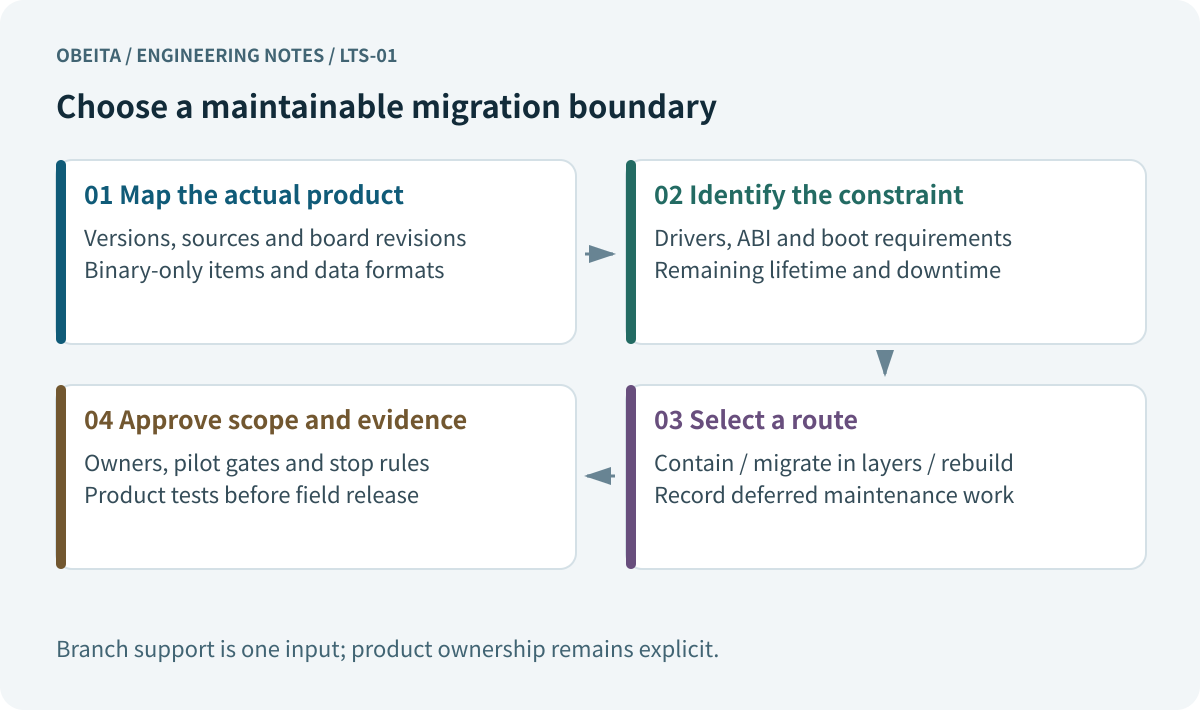
Begin with the image installed on representative shipped hardware. Record the SoC, board revision, boot ROM requirements, bootloader, kernel, device tree, Buildroot revision, compiler, libc and application version. Connect each item to its source archive or repository commit and to the person who can rebuild it. A directory named “final SDK” is insufficient identification when two engineers have different copies.
Add a recoverability column: available source and build instructions, available source without a working build, binary-only, or unknown origin. Record configuration and persistent-data formats as well. A network-facing service and an isolated manufacturing helper can need different treatment even when their versions are equally old. The inventory should make those differences visible without inventing a risk score that nobody can explain.
Separate LTS coverage from product responsibilities
On 10 October 2026, the official download page listed Buildroot 2025.02.18 in the 2025.02 LTS series, with end of life in March 2028. The project describes three-year LTS support starting with 2025.02. These dates concern the Buildroot branch; they do not extend a private BSP contract or guarantee support for every component in a customer’s image. See the LTS policy and dated release information.
Assign separate owners for evaluating upstream fixes, rebasing private changes, testing hardware and approving a field release. Include notification and response expectations in that agreement. If the intended device lifetime extends beyond the branch window, plan a later migration or a separate maintenance arrangement. “LTS” alone cannot fill that gap in the product plan.
Choose between containment, staged migration and rebuilding
There are three defensible starting routes. Contain the existing stack when rebuilding the hardware interface is currently blocked and the remaining exposure can be managed. Migrate in layers when user space and the build system can move while a vendor kernel is retained temporarily. Rebuild the board support when required drivers and boot requirements are understood and the future maintenance benefit justifies wider qualification.
Use the decision table as an initial filter, then document the evidence behind the choice. Retaining a kernel can reduce simultaneous change, but it also leaves that kernel’s patch and compatibility responsibilities in place. Check whether the selected userspace and toolchain work with the actual runtime kernel, including kernel-header requirements. A staged plan needs an explicit date or trigger for revisiting its deferred layer.
| Observed condition | Candidate route | Approval evidence |
|---|---|---|
| Essential driver is binary-only and incompatible | Contain current stack; investigate replacement | Exposure controls, maintenance owner, revisit date |
| User space can move; vendor kernel must remain | Staged migration | ABI/kernel checks, private-kernel patch plan |
| Drivers and boot chain have maintainable sources | Rebuild board support | Porting scope, board matrix, recovery plan |
| No reliable restoration path exists | Pause deployment planning | Recovery method demonstrated on authorized hardware |
Create a blocker register for patches and binary components
List every private patch with its base version, purpose, source and current owner. Classify it as already upstream, still required, replaceable, or unexplained. “Applies without conflict” is only a mechanical observation: a clock, DMA or power-management change can apply cleanly while its assumptions have become wrong. Unexplained patches should receive investigation tasks before they become silent long-term commitments.
For GPU, Wi-Fi and media binaries, ask for the supported kernel interfaces, CPU ABI, libc and firmware combinations. Include out-of-tree modules and provisioning utilities. Obtain redistribution and source-delivery requirements from the actual agreements and component licenses. A missing right to distribute a replacement binary is a release blocker even if the build works. Record who will resolve it rather than assuming engineering can repair it.
Estimate validation separately from porting
Estimate at least six work areas independently: source recovery, build restoration, code migration, peripheral regression, update and recovery qualification, and handover. Add an ongoing maintenance allowance for reviewing fixes and running the relevant tests. This avoids reporting only the visible porting task while hiding the cost of supporting multiple shipped board revisions.
Where uncertainty dominates, buy information before buying a full migration. For example, first establish whether a required binary can load with the proposed libc, or whether the recovery boot path remains available with a changed partition map. Give that investigation a deliverable and a decision owner. Use ranges tied to named unknowns; generic article estimates cannot justify a schedule or a fixed quote for an unseen BSP.
Set pilot gates and stop conditions
Choose a representative development board and preserve a known-good recovery image before the pilot. Define successive gates: inputs are identified, the new tree builds from a fresh output directory, the board reaches a controlled startup state, and selected critical functions pass recorded checks. The pilot should expose the highest-risk dependency, not merely the easiest configuration to boot.
Write stop conditions before work begins. Examples include a required binary without a compatible maintained alternative, an upgrade that cannot preserve necessary data, or a remaining support window shorter than the planned qualification cycle. Stopping at a gate can mean retaining the current release, narrowing the first migration or changing hardware. Record which outcome is authorized; do not let a failed experiment become an accidental production decision.
Produce an approvable migration scope
The approval packet should state target versions, affected hardware, included components, deferred components and the owner of every residual risk. Attach the patch inventory, the selected route, pilot evidence requirements, recovery prerequisites and the acceptance owner. Define what “done” means separately for an engineering build and for a deployable product release.
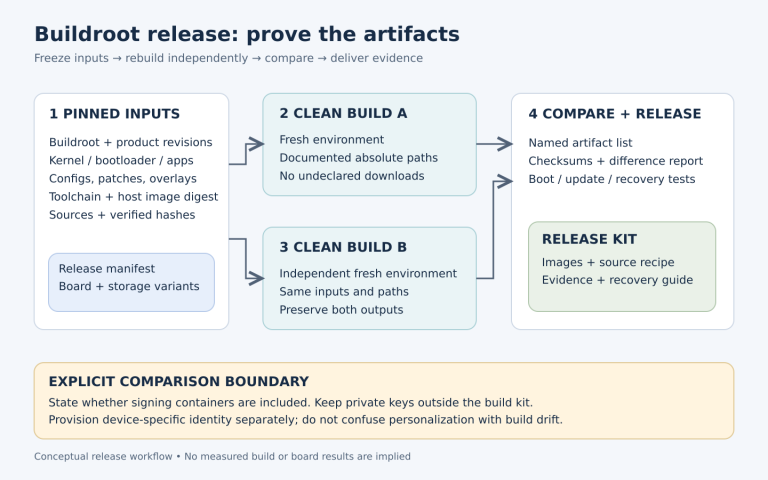
Once that scope is agreed, use the external-tree migration workflow for engineering execution and the system regression matrix for release decisions. Keep the existing Buildroot delivery-kit checklist as the packaging reference. A clear scope makes later changes reviewable: an unexpected driver replacement becomes a visible decision with new tests, rather than disappearing into a vague promise to “upgrade Linux.”
References and version boundary
Examples are engineering illustrations for the stated version. No board execution, full cross-build, performance benchmark or field-deployment result is claimed.
- Buildroot 2025.02.18 source archive
- Buildroot LTS policy
- Buildroot download and support dates
- Buildroot manual
For a focused BSP maintenance or build review, contact Obeita with the relevant version baseline, a sanitized configuration and the first complete failure log. Include the hardware or toolchain scope and the result you need to establish.