Test Fixtures with Switched Signal Paths: Verify the Selected Route Before Applying Stimulus
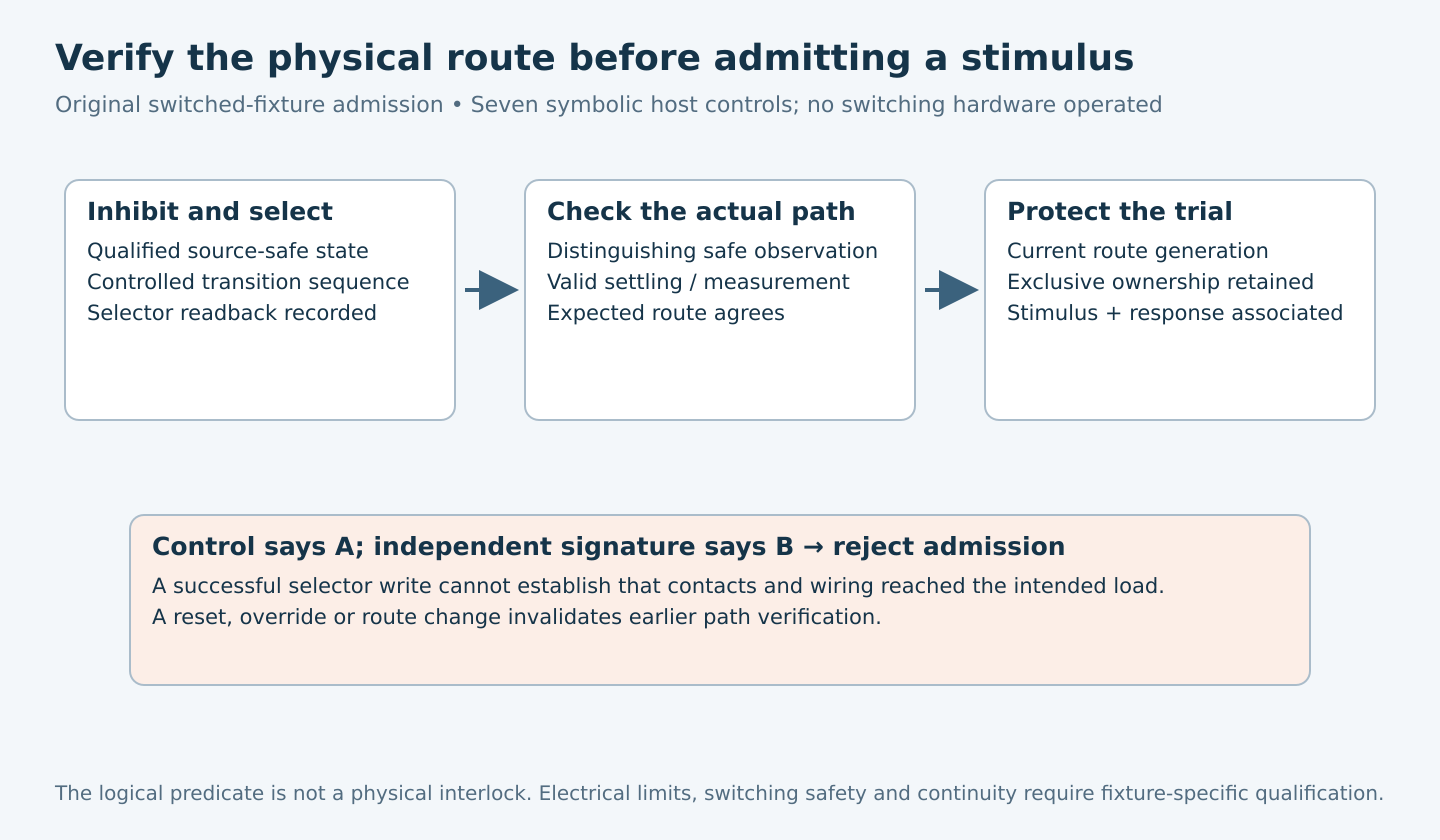
Before applying a test stimulus through a switched fixture, establish both the commanded selection and the physical path that selection produced. Keep the route under one owner through stimulus and observation. A selector register reading back the requested channel does not prove that the intended contacts, wiring and load are connected.
This is an original fixture-admission procedure informed by NASA SP-2016-6105 Rev2. Seven symbolic controls ran on CPython 3.12.14. No relay, analog switch, instrument or device was operated. The actual schematic, switch ratings, safe transition sequence and settling requirements must be qualified for the fixture.
Define the complete route
Give each permitted route an identity covering source, switch stages, measurement channel, return path and destination. Include shared grounds, protective elements and any intermediate patch panels. A channel number alone can omit the wiring that determines what receives the stimulus.
Record every actor capable of changing that route: test software, manual controls, instrument reset, power transitions and another worker. Decide who owns selection during a trial and which events revoke that ownership.
Keep the route map under configuration control. Replacing a harness or moving a connector can change physical routing without changing the selector’s software label. The required test association must follow the actual fixture revision.
Start from the qualified inhibited state
Before switching, put the stimulus source and connected system into the state required by the approved procedure. Depending on the design, this can involve disabling a source, verifying stored energy has decayed or disconnecting a sensitive destination.
Do not assume every switch is suitable for hot switching or that a software output-disable command establishes a safe electrical state. Contact ratings, break-before-make behavior, leakage, protection and stored charge are device-specific. Verify the actual parts and topology.
If the required inhibited state cannot be observed or established, stop. An unknown route with an active source is not an acceptable starting point for an improvised continuity check.
Separate control readback from path evidence
| Observation | What it can establish | Remaining gap |
|---|---|---|
| Command accepted. | The control interface accepted the request. | Selection may not have completed. |
| Selector state read back. | The controller reports the requested selection. | Contacts or wiring can still be wrong. |
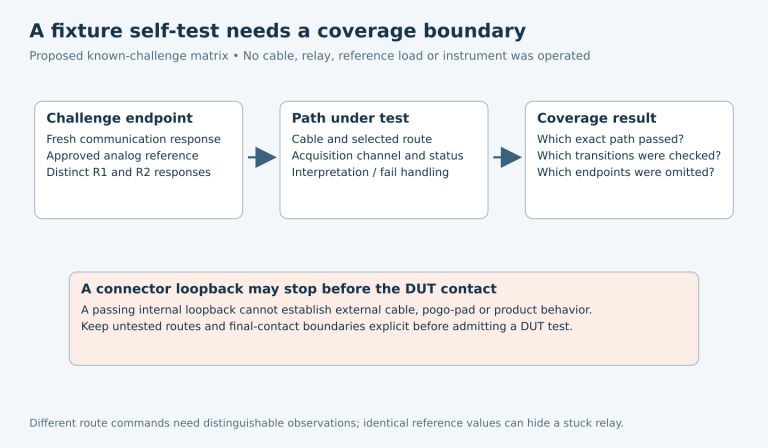
| Independent route signature observed. | The measured path agrees with a qualified distinguishing check. | Only the checked path and conditions are covered. |
| Route remains exclusively owned. | No permitted actor changes it during the protected trial. | Hardware faults still need detection and disposition. |
| Stimulus and response associated. | The result belongs to the admitted trial and route. | Other product requirements remain separate. |
A qualified path check might use distinct reference loads or another harmless distinguishing observation. Choose it from the real circuit, not from a generic recipe. A test signal safe for one input can damage another.
Define acceptable signature ranges with measurement uncertainty and component variation. If two routes produce indistinguishable signatures, the check cannot establish which one is selected. Mark that limitation rather than assigning the nearest nominal value.
Qualify switching and settling before measurement
Record the required transition sequence, including any all-open state, permitted simultaneous paths and settling observation. Use the actual switch and instrument specifications together with fixture qualification; a universal sleep cannot cover every source impedance, capacitance and load.
Where timing is used, start it at the relevant completed transition rather than merely at command submission. If readback is asynchronous, establish what its response means. A controller acknowledgement can precede physical stabilization.
Use a known valid route as a positive control and a deliberately mismatched record as a software negative control. Physical wrong-route challenges require an isolated fixture and an approved low-energy method; do not route a full operational stimulus into an arbitrary alternate input.
Bind admission to the current route generation
Increment a route generation whenever selection, reset, configuration or ownership changes. Bind the successful path check to that generation. Before stimulus, require the intended route, current generation, valid observation and exclusive ownership to agree.
The check and subsequent stimulus must occur within the same protected ownership interval. A predicate evaluated before releasing a lock does not prevent another actor changing the route afterward. The real implementation needs synchronization and, where required, independent hardware interlocks.
Invalidate admission on an unexplained readback, lost connection, reset or manual override. Do not reuse a cached successful path check after such an event. Restore a known state and requalify through the supported procedure.
Read the executed symbolic controls
The host model admitted a record only when stimulus was inhibited, expected route A matched control readback and an independently supplied path signature, generation values matched, settling was complete and ownership was exclusive.
Six altered records were rejected: physical signature B despite control A, missing control readback, stale verification generation, incomplete settling, nonexclusive ownership and a source not marked inhibited. All seven expected classifications passed.
These are symbolic evidence flags, not measured electrical facts. The model does not implement an interlock or prove that its state remains unchanged between admission and stimulus. It demonstrates the fields a real route-admission mechanism must establish and protect.
Preserve route failure separately from product failure
If path qualification fails, keep the product result incomplete. A low response obtained through an unverified route should not automatically be classified as a defective product. Preserve control logs, independent path observations and fixture revision for diagnosis.
The NASA verification and configuration-management guidance supports retaining equipment configuration and change history. Deliver those records with the trial’s route identity, generation, admission evidence, stimulus and response.
The final claim should name the path actually verified and its limits. A reliable switched fixture earns each result through a current physical association; it does not rely on a channel label remaining plausible after the wiring or selector state changes.