Industrial IoT Offline Operation: Specify the Outage Before Selecting an Edge Solution
An industrial IoT solution should describe what continues during an internet outage, what accumulates locally, and what must wait for reconnection. A working local dashboard is not enough to establish that new devices can authenticate, stored telemetry will survive maintenance, or the cloud will eventually receive every observation.
Treat offline capability as a set of separate requirements. The examples below use documented Azure IoT Edge and AWS IoT Greengrass behavior to make those requirements concrete. They are design-review examples, not measurements from a customer installation or a recommendation to migrate platforms.
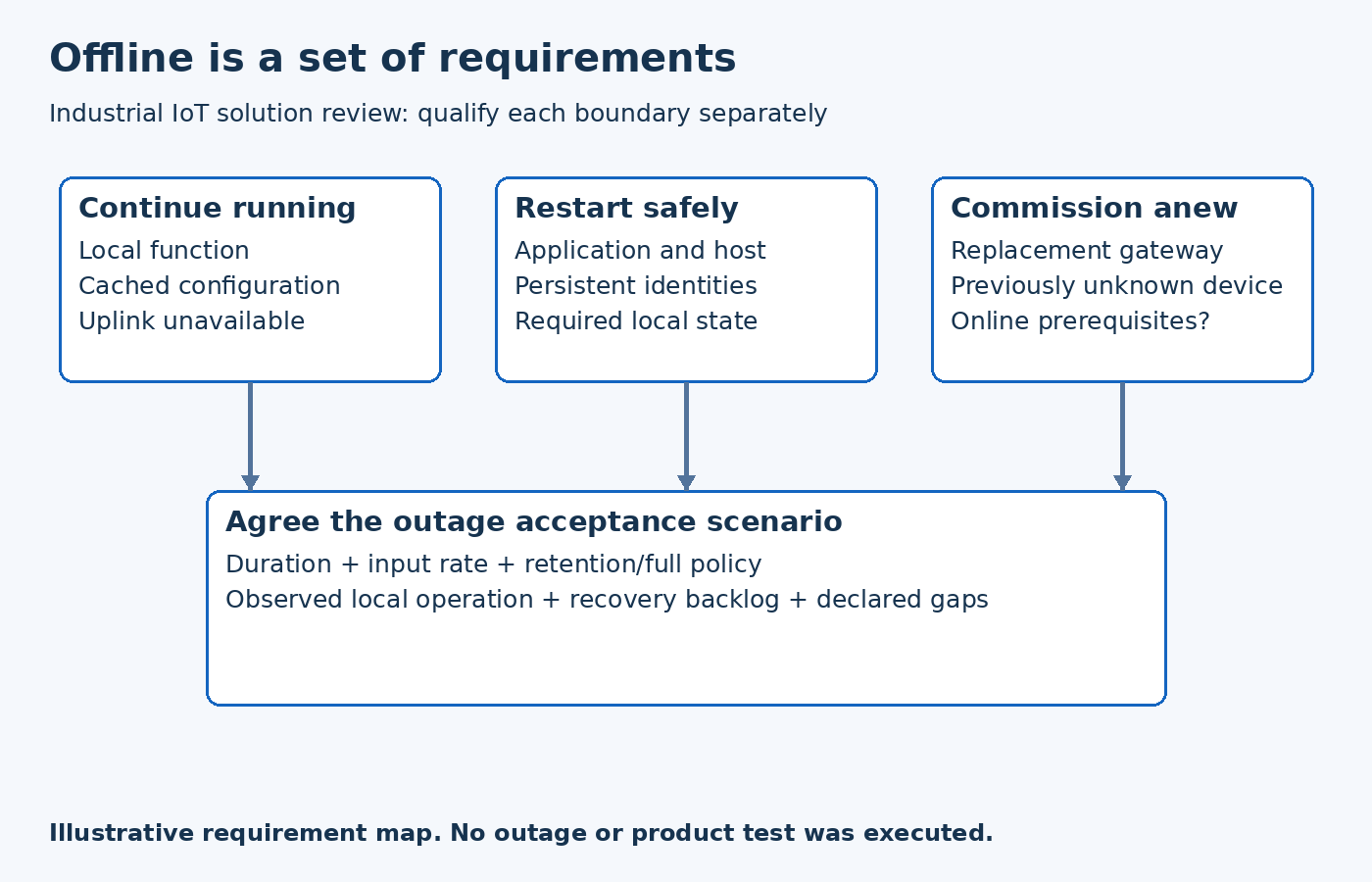
Separate running, restarting and commissioning
Start with three questions: can an already-running application continue, can the gateway restart, and can a previously unknown field device join? These events exercise different dependencies. A runtime may already possess code, configuration and identity information that a freshly commissioned installation lacks.
Microsoft's offline-capability documentation describes an initial online synchronization for IoT Edge and its assigned downstream devices. Cached information then supports offline authentication and operation. This is a reason to include a cold-start and enrollment boundary in a solution specification, rather than promising that an unopened gateway can be installed without connectivity.
For a hypothetical packaging line, write separate expectations for a running gateway losing its uplink and a replacement gateway arriving during that outage. If only the first case has a supported process, say so. Do not let an installation brochure silently extend an operating capability into an offline-provisioning claim.
Name the state that must survive
List application configuration, device identity information, queued telemetry and local analytical state separately. Decide whether each must survive an application restart, container replacement, operating-system restart or power interruption. Those are different acceptance events.
Azure's documentation recommends dedicated host storage for system modules rather than relying only on their container filesystem. Its host-storage guide explains the storage configuration used by modules. In a proposed deployment review, inspect the actual mount and ownership alongside the module configuration. A directory name in a design document does not prove which filesystem receives data on the target machine.
Use a disposable test installation for destructive interruption tests. Do not interrupt production equipment to find out whether a storage assumption was wrong. State explicitly which failure modes remain untested.
Define loss policy before choosing capacity
A buffer policy must answer what happens when retention time expires or storage fills. Keeping recent readings, preserving the earliest unexported records and stopping acquisition are different business behaviors. None is universally correct.
Greengrass Stream Manager's stream configuration distinguishes persistence, maximum stream size, retention and behavior at capacity. Its TTL is a period of data availability for consumption, not an immediate deletion schedule. Do not copy the meaning of a similarly named setting from another product.
For a hypothetical vibration-monitoring application, recent condition summaries might remain useful while a complete waveform history is optional. A different installation may require an explicit gap report whenever any waveform is discarded. Select the policy from the agreed data purpose, then size and test the implementation that enforces it.
Keep local operation separate from cloud visibility
During an outage, a cloud console cannot continuously observe every local transition. Microsoft specifically warns that portal deployment status can remain apparently healthy when an Edge device has no internet connection. Give operators a freshness timestamp and a local diagnostic path instead of presenting an old cloud status as a current site observation.
Similarly, Greengrass Stream Manager can manage local streams and subsequent exports. A locally accepted item and an item visible at the final destination are different milestones. Record enough identity to reconcile those milestones after recovery without treating a temporary queue count as a delivery receipt.
Write an outage acceptance scenario
A useful scenario specifies the initial synchronized state, outage duration, production data rate, allowed losses, restart event and recovery condition. Introduce a controlled uplink loss, observe the local function that matters, restore connectivity and compare independently recorded inputs with destination records.
Include an intentionally exceeded capacity or retention limit so the team can observe the agreed failure behavior. The acceptance result should identify preserved data, declared gaps and remaining backlog. This turns an ambiguous promise of offline operation into a solution boundary that hardware, firmware and site-integration teams can actually evaluate.