Industrial IoT Gateway Identity: Decide Whether the Cloud Must Manage Every Field Device
Before choosing an industrial gateway, decide whether the cloud needs to address each field device independently or only the gateway's aggregated data. A message containing a sensor identifier can support analysis, but that identifier alone does not create a separately managed device in the cloud platform.
This decision changes onboarding, configuration delivery, diagnostics and replacement procedures. Azure IoT Edge provides a useful documented example of the distinction. The design questions below concern integration scope; they do not imply that a translation module is included with every gateway or that a particular field device supports remote management.
Compare the identity models
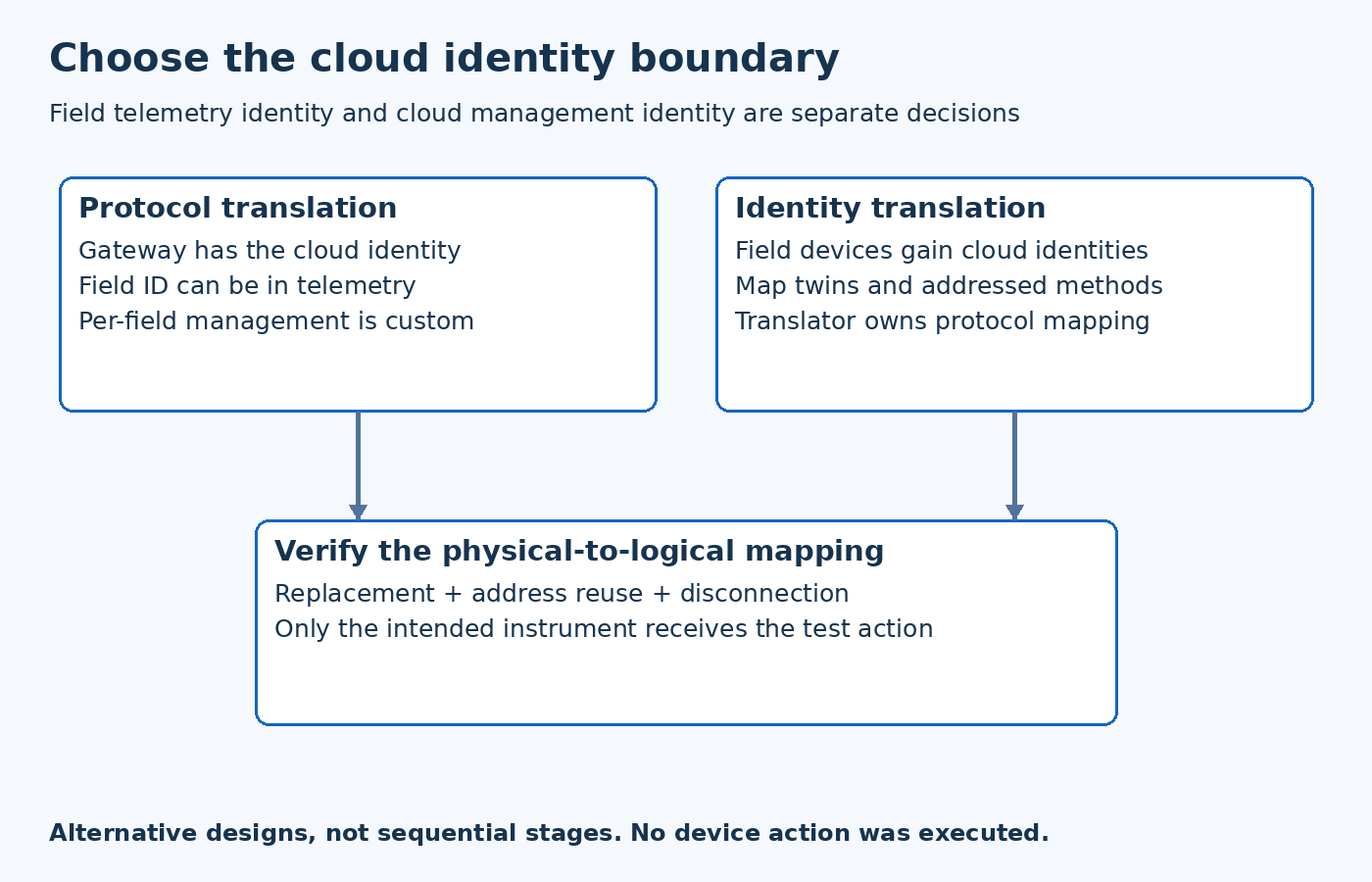
In Azure's gateway patterns, a transparent gateway serves downstream devices that already have identities with the same IoT Hub. Protocol translation converts otherwise unsupported field communication, while the gateway remains the cloud identity. Identity translation additionally represents downstream devices with their own IoT Hub identities.
Consider two hypothetical factories with identical serial temperature instruments. One needs only a site-level trend display. The other needs per-instrument configuration history and individually addressed maintenance actions. Both can collect readings, but their cloud-management requirements are different. Choosing an identity model from the number of serial ports would miss that distinction.
Keep the alternatives explicit. An opaque arrangement can include an instrument identifier in each telemetry record without providing a native device twin or individually addressed platform method for that instrument. Conversely, representing an instrument as a first-class cloud device creates implementation responsibilities for the translation layer.
Decide what an identity represents
Choose whether a logical identity follows a physical instrument, a measurement position or a replaceable module. These are application decisions, not automatically equivalent identifiers.
Suppose a fictional instrument at position Tank-3 is replaced. If the identifier follows the position, the historical stream may continue but should expose the hardware change. If it follows the physical unit, the new unit requires an association to that position. Either policy can work; an undocumented mixture makes maintenance records and telemetry joins unreliable.
Also decide how the gateway verifies its local mapping after a restart. A bus address reused by a replacement device is not necessarily evidence that it is the same physical instrument. Use the device's actual available identification features and document limitations where no reliable unique identity exists.
Map configuration and commands deliberately
IoT Hub device twins associate state with a device identity and distinguish desired from reported properties. That supports a configuration workflow, but a translator still has to map the requested property into the downstream protocol and report the actual outcome.
For a proposed sampling-interval change, define unsupported values, device rejection, temporary disconnection and successful application. Do not immediately copy a requested value into the reported state merely because the gateway received it. A gateway can acknowledge receipt while the instrument remains unchanged.
Direct methods use a request-response interaction for connected devices. Before exposing an instrument action through that interface, define the method response's meaning and timeout behavior. Long operations may need a separately tracked state workflow rather than pretending their initial acceptance means physical completion.
Microsoft documents device twins and direct methods as IoT Hub standard-tier features; include that tier requirement in the platform selection rather than assuming every IoT Hub tier supplies them.
Include the translation implementation in the scope
The IoT Edge runtime does not supply arbitrary protocol or identity translation automatically. Microsoft's gateway documentation identifies these as custom or third-party module responsibilities. Require a supported mapping for the actual instrument family, protocol revision and required management operations.
Evaluate more than a happy-path reading. Ask whether the module can distinguish two identical instruments, recover after an address changes, reject an unknown device, and keep one device's configuration from being sent to another. If management is intentionally unsupported, preserve that limit instead of describing the gateway as fully managing every downstream asset.
Test the replacement and disconnection cases
A compact integration exercise uses two artificial device identities and different visible values. Disconnect one instrument, replace or readdress it under the approved process, and verify which cloud identity receives subsequent readings. Then target a harmless test configuration and confirm that only the intended instrument changes.
No such test was executed for this article. The proposed result is a reviewable identity map, supported operation list and replacement procedure. Those deliverables let a team choose between aggregation and per-device management before discovering the difference during commissioning.